
SEO copywriting is the foundation of successful website promotion. When we first launched the BUSINESS SITE web studio, I quickly realized that without quality SEO text, our website simply wasn’t visible on Google, forcing us to allocate a significant budget for contextual advertising.

Even the most modern and beautiful website design won’t bring results if it lacks properly written texts that answer user queries and meet search engine requirements. I’ve personally realized that SEO copywriting isn’t just part of the strategy—it’s its foundation.
In this article, I’ll share how to write SEO texts that actually work. These are the methods we use in our studio and which help our clients rank in top positions in search engines and consistently get a flow of leads.
SEO Copywriting Basics
SEO promotion and copywriting are closely linked because the goal of any text is not only to convey information but also to bring targeted visitors to the site. If the text is written correctly, it helps improve the website’s visibility in search engines, increases traffic, and most importantly, converts visitors into customers.
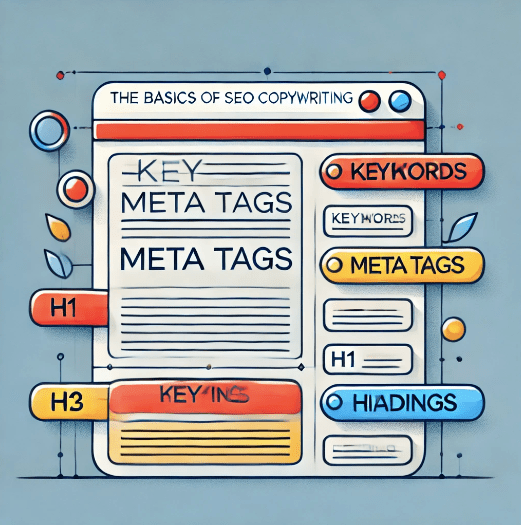
Key elements of an SEO text:
- Keywords. These are terms and phrases users enter into search engines to find information. For example, if you’re writing an article about website promotion, keywords might include “SEO copywriting,” “website optimization,” or “how to improve Google rankings.” However, it’s important to remember: keyword stuffing is long gone. Google’s algorithms have become smarter, and instead of promoting sites with artificial keyword use, they focus on natural content that is useful to the reader.
- Meta tags. These are the titles and descriptions that appear in search results. The importance of meta tags cannot be overstated, as they significantly affect click-through rates (CTR). Example: if your title tag reads “SEO Copywriting for Business: How to Attract Clients with Text,” it immediately grabs attention and encourages clicks. Meta tags should be short, precise, and include keywords, but without looking spammy.
- Headings. The correct structure of the text is one of the factors that determines its success for both readers and search engines. Headings (H1, H2, H3) help both users and search engines better understand the content of the article.
For example, H1 is the main heading, which should clearly reflect the topic of the text and include the keyword. Subheadings H2 and H3 break the text into logical blocks, improving its readability and structure.
E-A-T Principle
To rank well in search, it’s essential to demonstrate:
- Expertise: The content must be written by a specialist or reviewed by an expert in the topic.
- Authoritativeness: Use links to authoritative sources, case studies, and customer testimonials.
- Trustworthiness: Make sure the information in the text is up-to-date, accurate, and supported by facts.

The Importance of LSI (Latent Semantic Indexing)
These words help search engines understand that the text truly answers the user’s query.
Beginner SEO Copywriter Mistakes
This makes the text unnatural, disrupts its flow, and may cause negative reactions from both readers and search engines. It’s essential that keywords fit organically into the context, as if they are a natural part of the text, rather than being artificially added.
Another common mistake is a lack of structure. Large blocks of text without subheadings, lists, and other formatting elements make it difficult to absorb information. Readers, especially on mobile devices, are likely to leave such a page without finishing it.
Sales-Oriented Texts and SEO Copywriting
For a text to be sales-oriented, it must:
- Clearly convey the value of the product or service. For example, if you’re writing an article about SEO services, explain how they will benefit the business. It’s important to communicate the value: improving website rankings, attracting more clients, increasing revenue.
- Use calls to action (CTA). Examples: “Request a free audit,” “Learn how we can improve your website,” “Get a consultation now.”
- Convince the user of the company’s professionalism and reliability. This can be done through real examples, client testimonials, and case studies.

SEO copywriting is not just about optimizing text for search engines. It’s about creating high-quality, useful, and well-structured content that attracts and holds the attention of your target audience, helping convert traffic into real clients.
User Search Intent
For successful SEO copywriting, it’s important to understand the “search intent” of the user, which refers to the purpose behind a search query and the type of answer they expect to receive.

Search queries can be classified into several types, each requiring a different approach when creating pages and writing content.
- General queries
Example: “SEO“, “Travel agency”.Characteristic: These are very broad search queries. They usually generate a large amount of traffic but rarely lead to conversions because the user’s intent is unclear at this stage. People may simply be looking for general information without a specific goal (e.g., to buy a service or product).How to handle: For general queries, it’s worth creating “overview pages” or “guides” that give a general understanding of the topic. They serve to attract a broad audience and help position your website as a source of expert knowledge. However, don’t expect quick results in the form of sales from these queries.
- Navigational queries (brand queries)
Example: “Business Site web studio”, “Business Site website”.Characteristic: The user already knows which website or brand they are interested in and uses a search engine for quick access to it. Navigational queries usually result in high conversion rates, as the user is already set on interacting with a specific company.How to handle: For navigational queries, it’s important to ensure “correct ranking of the main page” and key information pages about the company. Make sure your website ranks at the top for such queries. It’s crucial to properly configure **title and description** to help users quickly find the right page.
- Media queries
Example: “SEO videos,” “marketing podcasts”.Characteristic: These queries are aimed at finding multimedia content—videos, podcasts, images. Such queries can bring good traffic, especially if your site offers useful and popular multimedia materials.How to handle: For such queries, it’s necessary to create “media content pages”—video tutorials, podcasts, infographics, and other formats. Optimize your YouTube videos and embedded clips by adding keywords to titles and descriptions. It’s also important to use “alt-tags” for images so search engines can properly index the media.
- Informational queries
Example: “how to write SEO texts,” “what is contextual advertising”.Characteristic: The user is looking for specific information to solve a problem or study a topic. These queries generate a lot of traffic but don’t always lead to direct sales, as users at this stage are more focused on finding information.How to handle: Informational queries require creating “detailed, expert content.” This could be articles, guides, blogs, or FAQ pages. The key is to provide clear and complete answers to user queries. These pages help build trust and expertise, which over time can lead to increased conversions.
- Geo-dependent queries
Example: “SEO services in Kyiv”, “restaurant in New York”.Characteristic: The user is looking for products or services tied to a specific geographic location. These queries bring in high-quality traffic because they often indicate a user’s readiness to make a purchase or use a service.How to handle: For such queries, you need to create “geo-optimized pages.” Use location-related keywords (e.g., “web studio in Kyiv”) and add company information, including address, contact details, and a map. It’s also important to work with Google My Business and other local services to ensure your company appears in local search results, but that’s beyond the scope of this article 😉
- Transactional queries
Example: “buy iPhone”, “order pizza”.Characteristic: These are queries with the intention of making a purchase or ordering a service. Such queries have the highest potential for conversion because the user is ready to take action.How to handle: For transactional queries, create “sales pages” with a clear description of the service or product and strong calls to action (CTA). These pages should be conversion-focused, with easy-to-use order forms and clear offers. Example: “Order an SEO audit now and get a detailed report within 48 hours.”
Once transactional pages are set up and working, you can expand your content strategy by adding **informational pages** to attract a broader audience that may not yet be ready to buy but shows interest in the topic.

Thus, understanding search intent and creating separate pages for different types of queries allows you to effectively promote your website and meet the needs of various user groups.
Structure and Formatting of SEO Text
The proper structure of a text is crucial not only for user readability but also for search engine promotion.
 Optimizing structure and formatting helps achieve this.
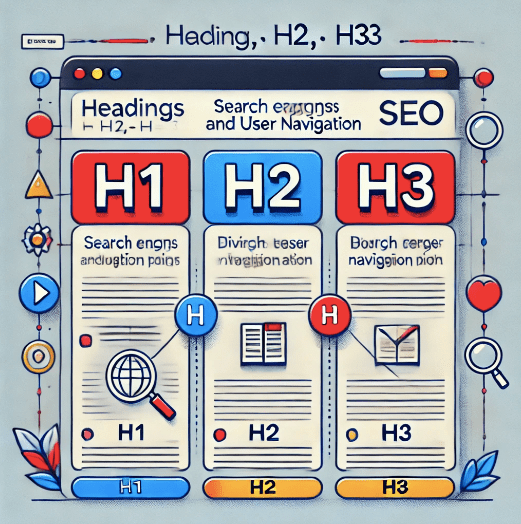
Search engines like Google use headings to better understand the content of a page, and users use them to navigate through the text quickly.
- H1 — the main heading of the page, which should clearly reflect the topic and contain the main keyword. This heading is used once per page.
- H2 — second-level headings that help divide the text into main sections. For example, if you have a section on SEO text optimization, it should be formatted as H2.
- H3 and below — lower-level subheadings that highlight subcontent within sections. For example, SEO analysis tools can be formatted as H3 within the section on keyword research.
Short Paragraphs
Modern users prefer to “scan” a page, quickly glancing through the text and stopping at key points. Therefore, short paragraphs are a must for easy reading.
Each paragraph should convey one specific idea. Don’t overload paragraphs with multiple ideas at once.
Lists and Tables
- Numbered lists are suitable for step-by-step instructions or processes.
If you’re explaining how to conduct an SEO audit, it’s better to do it in a list format. - Bullet points are great for listing features, tools, or benefits. Example: a list of SEO analysis tools:
- Google Keyword Planner
- Ahrefs
- Yoast SEO
- Tables are convenient for comparing data or showing numbers. For example, you can create a table with metrics from different tools or compare several methods of website optimization.
Block Layout of the Page
This structure makes the page more organized and easier to read.
- Text blocks. Divide text into visually separated blocks with spaces. This creates “airiness” on the page and prevents users from becoming fatigued from solid text.
- Graphic elements. Visual elements like images, infographics, or charts break up the text and help make the information more digestible. However, it’s important to maintain balance, so graphics don’t distract from the main content.
- Spaces. There should always be spaces between text blocks and images to visually separate information. For example, after each subheading and before the next paragraph, leave a small space to help the reader easily switch between topics.
Anchor Links for Long Pages
When an article or page contains a lot of information, especially if it consists of several thousand characters, it can be hard for users to navigate.
This approach is successfully applied by Wikipedia, and as you may have noticed, it’s also implemented on our website. 😊
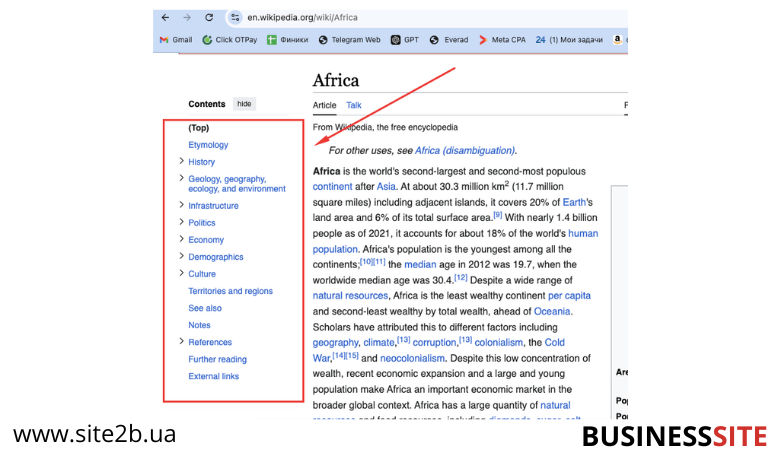
- Anchor links can be used to jump to sections with subheadings. For example, if you have a long article with sections on “Keywords,” “Meta Tags,” “Headings,” you can place navigation with links at the top of the page to allow quick access to each of these sections.
- This not only improves user experience but also increases the time spent on the page, which positively impacts SEO.
Break Up Text with Graphics
Although visual content is not directly related to copywriting, its use plays an important role in how a text is perceived.
- Images and infographics help visualize complex processes or data. For example, if the text talks about statistics or figures, a graph or infographic can make it more understandable.
- Screenshots can be useful if you’re describing how to use a tool or program. For example, when explaining how to work with Google Analytics, screenshots of the interface will help users better understand where to find specific data.
Using Neural Networks in SEO Copywriting
Neural networks have become an important and powerful tool in modern SEO copywriting. Thanks to their ability to analyze large amounts of data and generate text based on keywords, neural networks help speed up routine processes and improve SEO content optimization.
Content Generation: Pros and Cons
Neural networks, such as ChatGPT, can generate texts based on keywords or user queries. This is especially useful when you need to quickly draft an article or come up with ideas for a blog. For example, if you need to write an article on “SEO copywriting,” a neural network can provide a general text that can be used as a starting point.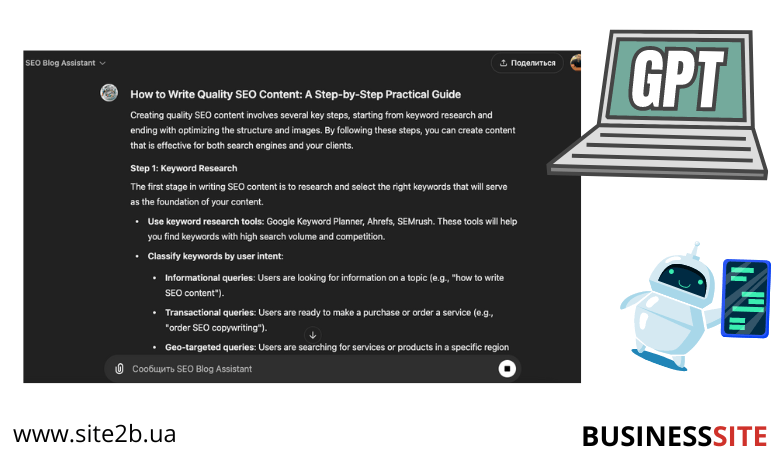
However, it’s crucial to understand key limitations:
- Lack of a unique approach. Neural networks generate content based on patterns found on the internet. This means that the texts they create may be too general and lack individuality.
- Clichés and banalities. Neural networks often use clichés and repetitive phrases found in other articles. This lowers the quality of the text and makes it less engaging for the audience.
- Errors and inconsistencies. Like any other algorithm, neural networks can make logical or factual errors. For instance, the text may contain inaccurate data or contradictions.
ChatGPT can provide a blog text outlining the key benefits of SEO. However, without manual refinement, this text may be too generic or fail to highlight the unique aspects of your business. To make it truly effective, it needs to be adapted and supplemented with real experience.
Text Analysis and Optimization
Tools like Grammarly or Yoast SEO analyze text for readability, grammar errors, and SEO indicators. These tools help identify potential issues in the text and suggest improvements.

Automating Routine Tasks
With the help of neural networks, you can:
- Automatically check keyword density in a text to avoid both overuse and underuse.
- Create meta tags and headings based on the main text.
- Analyze competitors. Neural networks can quickly analyze competitors’ websites, identify the keywords and strategies they use, helping you improve your own content and stay ahead of them in search rankings.
- Proofread texts. Neural networks can also be effectively used for proofreading texts and eliminating grammatical errors.
Human Touch in SEO Copywriting
Despite all the advantages of neural networks, good SEO copywriting always requires human involvement, known as the “human touch.” Neural networks can help automate part of the work, but they cannot create truly unique and compelling content that fully adheres to the E-A-T principle I mentioned earlier in this article.
Why Human Experience Matters:
- Unique content. It’s important to remember that search engines like Google prioritize original content. Texts generated by neural networks may not be unique because they are based on existing data. Only a human can create content based on the unique experience of the company.
- Sales appeal. A copywriter knows how to address customer pain points, craft offers, and use calls to action (CTA) effectively. A neural network cannot fully understand user psychology and write a text that is both informative and persuasive.
- Audience adaptation. A copywriter understands the target audience better than a neural network. They can choose the right tone, style, and approach to make the text resonate more with readers. For example, B2B content needs to be more data-driven, while B2C content tends to be more emotional.

Neural networks and artificial intelligence are powerful tools that help SEO copywriters automate routine tasks and improve texts. At the same time, you cannot fully rely on them because they make mistakes, generate bland texts, and cannot convey a company’s unique experience.
How to Write High-Quality SEO Text
As a reward for reading this far, I’d like to provide a practical guide on writing quality SEO text—the techniques I personally use when writing for the BUSINESS SITE web studio. So, let’s get straight to the practice!

- Keyword Research
The first step in writing SEO text is researching and selecting keywords that will form the basis of your content.- Use keyword research tools: Google Keyword Planner, Ahrefs, SEMrush. These services help you find keywords with high search volume and competition.
- Classify queries by user intent:
Informational, Transactional, Geo-dependent, and so on.
Tip: for business promotion, it’s better to start with transactional queries, as they bring the most leads, and then expand the content to cover informational and geo-dependent queries. - Structuring the Text
Once the keywords are defined, the text needs to be properly structured to make it user-friendly and SEO-effective.- Use H1, H2, H3 headings. H1 is the main heading of the page and should contain the main keyword. H2 and H3 help divide the text into logical sections, improving readability.
- Short paragraphs. Write short paragraphs of 2-3 sentences to make the text easier to digest.
- Add lists and tables. They help highlight key points and make the text more user-friendly.
Example: if you have an article about SEO auditing, the H1 heading could be “What is SEO Auditing and How Can It Help Your Business?”, H2 could be “Main Stages of SEO Auditing,” and H3 could be “Tools for Conducting an Audit.” - Adding Multimedia
Text without visual elements can be boring and hard to digest. Break up the text with graphics, images, and videos to improve user interaction with the content.- Use images and infographics to illustrate complex topics or visualize data. For example, graphs showing traffic changes after SEO optimization. You can create them by taking screenshots of service interfaces or generating them in Excel. For creating illustrations, use https://www.canva.com/ or neural networks for image creation.
- Don’t forget about alt tags for images—this helps search engines better understand what’s depicted in the image and increases the chances of appearing in image search results.
- Optimizing Meta Tags
Meta tags play a key role in a page’s ranking and click-through rate. Optimizing the title and meta description will improve search rankings and increase CTR (Click Through Rate).- Title—should include the main keyword and be no longer than 60 characters. Example: “SEO Copywriting for Business: How to Attract Clients with Text.”
- Meta description—briefly describe the content of the page and add a call to action. Example: “Learn how to write SEO texts that will help your website rank high on Google.”
- Optimizing Page Length and Navigation
Long articles require good navigation to help users quickly find the sections they need.- Use anchor links. If the article is long and consists of several sections, create navigation with anchor links at the beginning of the article to help users quickly move through the page.
- Add internal links to other pages on your site to improve engagement and SEO.
Example: if an article on SEO copywriting has sections on keyword research, content creation, and analysis, add anchor links at the start of the article for quick navigation.

Proofreading and Editing
Once the text is ready, be sure to proofread, review, and optimize it.
- Use tools to check grammar and style, such as ChatGPT, Grammarly, or Hemingway, to improve text readability.
- Analyze keyword density and text structure with tools like Yoast SEO, ChatGPT to ensure the text is well optimized without being overloaded with keywords.
- Check the uniqueness of the text using plagiarism detection services like Advego or Copyscape.
- Add sales elements to the text—calls to action (CTA), unique value propositions (UVP), and real case studies to stand out from the competition.
Rate the article:





