
Properly optimized texts not only help improve website rankings, but also significantly reduce costs for contextual advertising.
The 2024 trends show that search algorithms are becoming even smarter, and a website’s success depends not on the number of keywords but on the quality of the content, its uniqueness, and its usefulness to users.
In this article, I will explain in detail what an SEO text should look like to not only attract traffic but do so efficiently and with minimal costs. We will cover the main mistakes, the principles of creating quality text, as well as modern SEO trends. Ready to get your website to the top? Let’s begin!
What is SEO text?
Differences between SEO text and regular content
- Use of keywords
SEO text includes carefully selected keywords that users type into search engines. These words help search algorithms understand what the article or webpage is about and assess its relevance to user queries. - Relevance and usefulness
SEO text should address specific questions and user needs, making it more targeted compared to regular content. Search engines like Google increasingly focus on the quality and usefulness of content.
Use of LSI (Latent Semantic Indexing)
One of the modern approaches in SEO is the use of LSI (Latent Semantic Indexing) keywords. These are not direct key phrases but words and terms related to the main topic.For example, if the main keyword is “website development“, LSI words may include phrases like “website design“, “web development”, “internet marketing”.This helps search engines better understand the context of the page and determine its usefulness for users.
- Text structuring
SEO texts are always structured in a way that is easy to read both for users and search engines. This includes headings (H1-H3), short paragraphs, lists, and highlighting key points. Proper structure helps search bots “read” the page more easily and allows users to quickly find the information they need. - Meta descriptions and tags
Another difference between SEO text and regular content is the need for meta tags (title, description), which help improve page visibility in searches. These elements are not directly visible to users on the page, but they play a crucial role in website ranking.
Structure of an SEO text
The right structure of an SEO text not only ensures user-friendliness but is also a key factor for the successful ranking of a page in search engines.
Let’s break down how to properly structure an SEO text.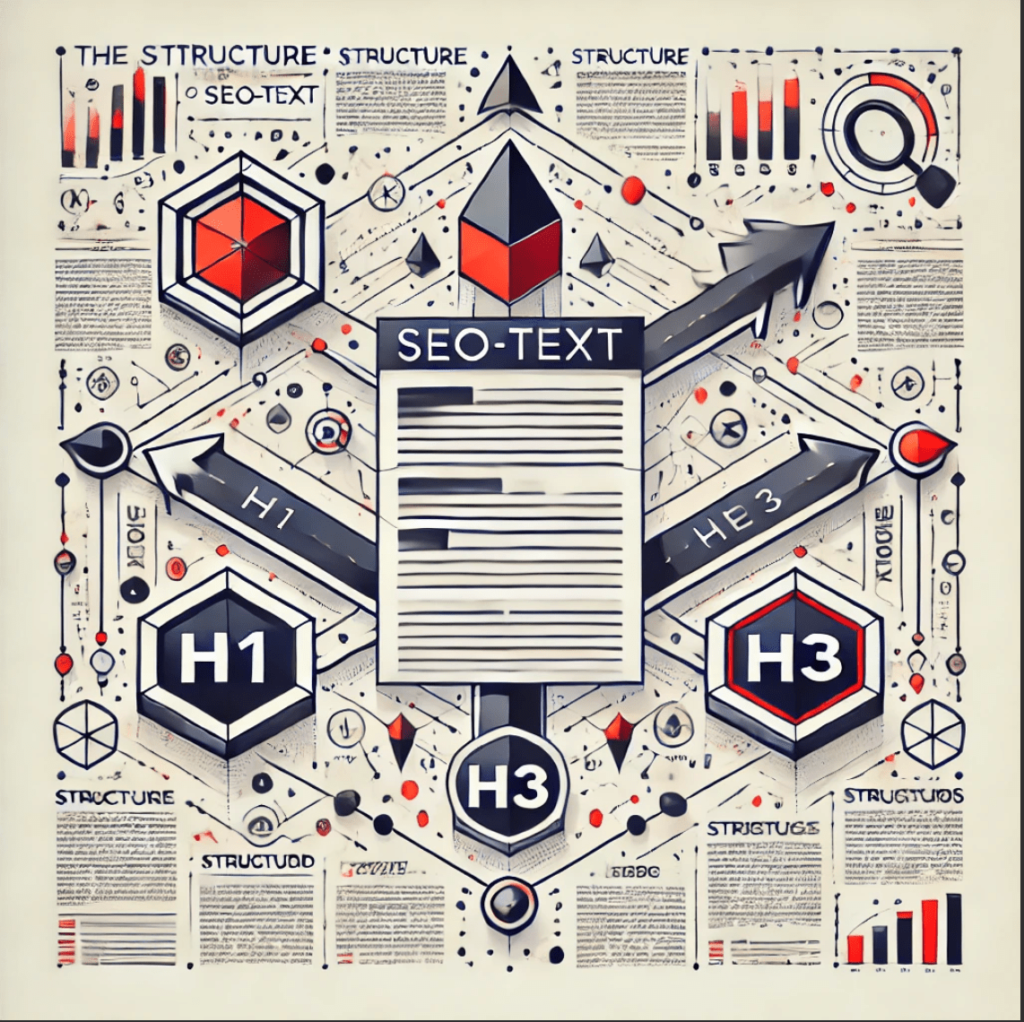
Headings and keywords
In SEO text, headings must be properly organized in a hierarchy:
- H1 — the main page title
This is the most important heading, which should clearly reflect the page’s topic and include the main keyword. For example, if your article is about creating SEO text, the H1 heading might look like this:
“How to write an effective SEO text to promote your website.”Important: there can only be one H1 heading on a page. This heading defines the main focus of the content. - H2 headings are used to divide the text into major sections. These subheadings should also include keywords or LSI keywords (related terms) but in a more natural way. For example, in an article about SEO text, H2 headings might look like:
“Structure of SEO text”,
“How to correctly use keywords in SEO text.” - H3 and lower — subheadings for further detailing
H3 and lower subheadings are used to further break the text into smaller sections. They can describe individual aspects of the topic. Additional keywords can be used here, but the main thing is that the text remains natural and useful to the reader.
Block structure of the text
Here are a few ways to structure the text:
- Bulleted lists help highlight key points and recommendations. They are easy to read and help users quickly grasp key ideas.
- Numbered lists are suitable for step-by-step instructions, guides, or any processes where the order of actions is important.
For example:
- Conduct keyword research.
- Optimize headings and meta tags.
- Regularly update the text.
- Tables help organize information, especially when comparing data or structuring a large amount of information. For example, you can compare the effectiveness of different SEO promotion strategies or show test results.
A well-structured text improves user experience (UX) as it helps readers find the necessary information faster and reduces the chances of them leaving the page without finding the answer they need.

Using multimedia to enhance content
A modern SEO text should be enriched with multimedia elements such as images, videos, and infographics.
The functions of multimedia are:
- Capturing attention
Multimedia elements help break up large amounts of text and keep the user’s attention longer. Studies show that users are more likely to leave pages with long, unstructured texts, but the presence of visual elements such as images or videos keeps them on the page longer, exploring the content. - Interactivity
Videos, interactive charts, or image carousels create an interactive user experience. This not only keeps users engaged but also motivates them to interact with the site, increasing engagement, which in turn improves rankings in search results. - Building trust
Visual elements like real product photos, video reviews, or case studies help build trust with users. For example, online stores with high-quality images and video reviews attract more customers as users can see the product in real life.
Thus, it is worth embedding the following into website texts:
- Images help make the text more visual and easy to understand. However, it’s important not just to insert a picture into the text but to optimize it for search engines:
Use descriptive file names (alt tags) and compress images so they don’t slow down page loading. - Video content is growing in popularity, and search engines are taking this into account. Pages with video often rank higher in search results. This is especially noticeable in educational topics where video can explain complex processes much faster and more effectively than text.
- Visualizing data with graphs and charts helps better understand numbers and statistics, making it easier to grasp complex information. Like infographics, they increase user engagement and make the content more attractive.
The E-E-A-T principle

- Experience
For example, if an author writes an article about the benefits of diets and mentions that they have personally gone through this experience (such as following a specific diet for six months), this gives the content more weight in terms of experience. Google ranks such content higher than materials created by people who have no personal connection to the topic.Therefore, when writing articles, share your personal experience, how you or your colleagues solved a particular problem, instead of just listing commonly known facts that can be found on Wikipedia. - Expertise
Expertise means the author has deep knowledge and competence in the subject matter. Content written by experts in their field has a better chance of ranking higher in search results.Articles written by medical professionals will rank higher in the “Health” section than materials created by individuals without relevant education.
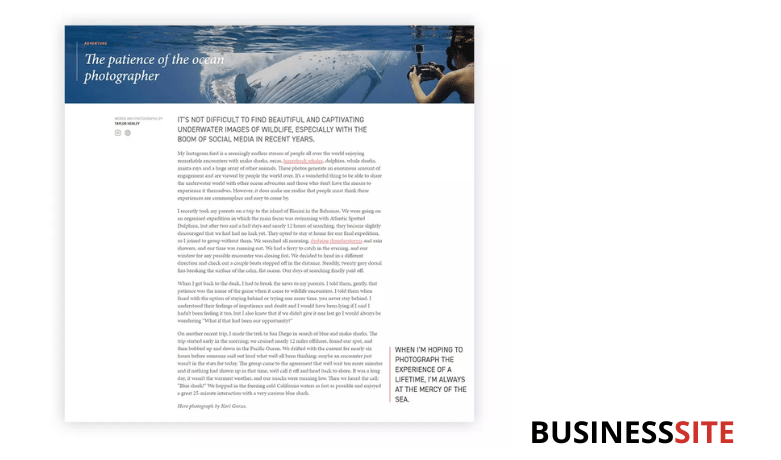
That’s why it’s important to include your photo under each article, along with a link to your profile, where information about you as an expert is available.This is how it is implemented in the blog on the BUSINESS SITE web studio website and on the page of this article that you’re reading now.
- Authoritativeness
Authoritativeness means recognition and trust in the author or site from other resources and users. Google evaluates how widely known the author or website is in its field and how often it is referenced by other sources. The more quality external links from authoritative sites pointing to your page or site, the better your chances for successful ranking.Example: if your web development site is cited or referenced by major tech publications or blogs like TechCrunch or Smashing Magazine, this indicates high authority. Mentions of the site or author in professional communities, scientific publications, or forums are also important.Therefore, I recommend creating accounts on thematic platforms and being active on them. - Trustworthiness
Trustworthiness relates to how reliable the site or author is. To assess this, Google evaluates not only the resource’s reputation but also its technical aspects — site security, the presence of contact information, transparency, and compliance with privacy standards.If an online store has positive reviews, an SSL certificate, and clearly listed contact information, this helps build trust with both users and search engines.A website that does not provide this information or has many negative reviews will rank lower. - Over-optimization (Keyword Stuffing)
One of the most common mistakes in SEO is the excessive use of keywords. Inserting key phrases into every paragraph or using them too frequently is considered “keyword stuffing,” which negatively impacts both user experience and search engine rankings.Example of a mistake:
“Buy cheap tires in Kyiv. Our store offers cheap tires in Kyiv at great prices. If you need cheap tires in Kyiv, contact us, we have cheap tires, we are located in Kyiv.”How to avoid it:
Use keywords organically so that the text appears natural. Use synonyms and LSI (Latent Semantic Indexing) keywords, which help diversify the vocabulary while maintaining meaning.Instead of constantly repeating “cheap tires in Kyiv,” you could use phrases like “buy tires at a great price in Kyiv.” - Lack of relevance and usefulness for the user
Many make the mistake of focusing solely on search engines and forgetting about the real needs of users. This results in a text filled with keywords but lacking specific answers to user queries or failing to provide value to the audience.Example of a mistake:
An article with the title “How to choose car tires” might contain text that reads more like an ad than a guide: “We offer the best tires at great prices,” instead of real tips and recommendations.How to avoid it:
Write your texts with your audience’s interests and needs in mind. The content should solve the user’s problems, offer useful advice, or explain how to choose and use a product or service.Trust me, if your articles are useful to people, search engines will reward you with higher rankings, and users will eventually become loyal customers. - Poor content quality and lack of uniqueness
Using template or copied content is a serious mistake.Copying entire texts from other websites is a cardinal sin! Never do this, or you can forget about high rankings!But search engines, especially Google, may also deem a text unoriginal if it only presents common, well-known facts without offering personal experience or a unique perspective on solving a problem.
How to avoid it:
Create unique materials, even if you are describing common products or services. Be creative and add your own approach to the description to make the content original and useful. This will improve your chances of achieving high search rankings. - Ignoring user experience (UX)
One of the most important aspects of SEO is user experience (UX). Even if your text is optimized for search engines, if it’s difficult to read — with long paragraphs, no headings, and poorly structured content — users will leave the page. A high bounce rate signals to search engines that the content is poor, which lowers its rankings.
Example of a mistake:The text on a site is presented as one huge block without any headings or paragraphs — I call this a “brick of text” 😊 This greatly complicates the readability of your content!How to avoid it:
Structure your text. Use H1-H3 headings to divide the content into logical sections, short paragraphs, bulleted lists, and tables to help users easily scan the page and find the information they need. - Lack of multimedia
Modern users expect more than just text. Content that consists only of text, without images, videos, or infographics, loses in terms of attractiveness and user retention. This also impacts behavioral factors like time spent on the page and depth of interaction. - Unoptimized meta tags and descriptions
Meta tags and descriptions play an important role in SEO, but they are often overlooked. The title and meta description are the first elements users see in search results. Whether users click on your website depends on how informative and appealing these elements are.Example of a mistake:
Lack of keywords in the title or a too-short, uninformative page description.How to avoid it:
Pay attention to crafting meta tags. Include keywords in your titles and descriptions, making them relevant to the page content.Example of a good title: “How to choose winter tires: 5 practical tips” with a description: “Learn how to choose winter tires for your car to ensure safety on the road.”
Common mistakes when creating SEO text
To ensure that your text positively impacts traffic and improves search engine rankings, it’s important to avoid a number of common mistakes that are often made by inexperienced authors. 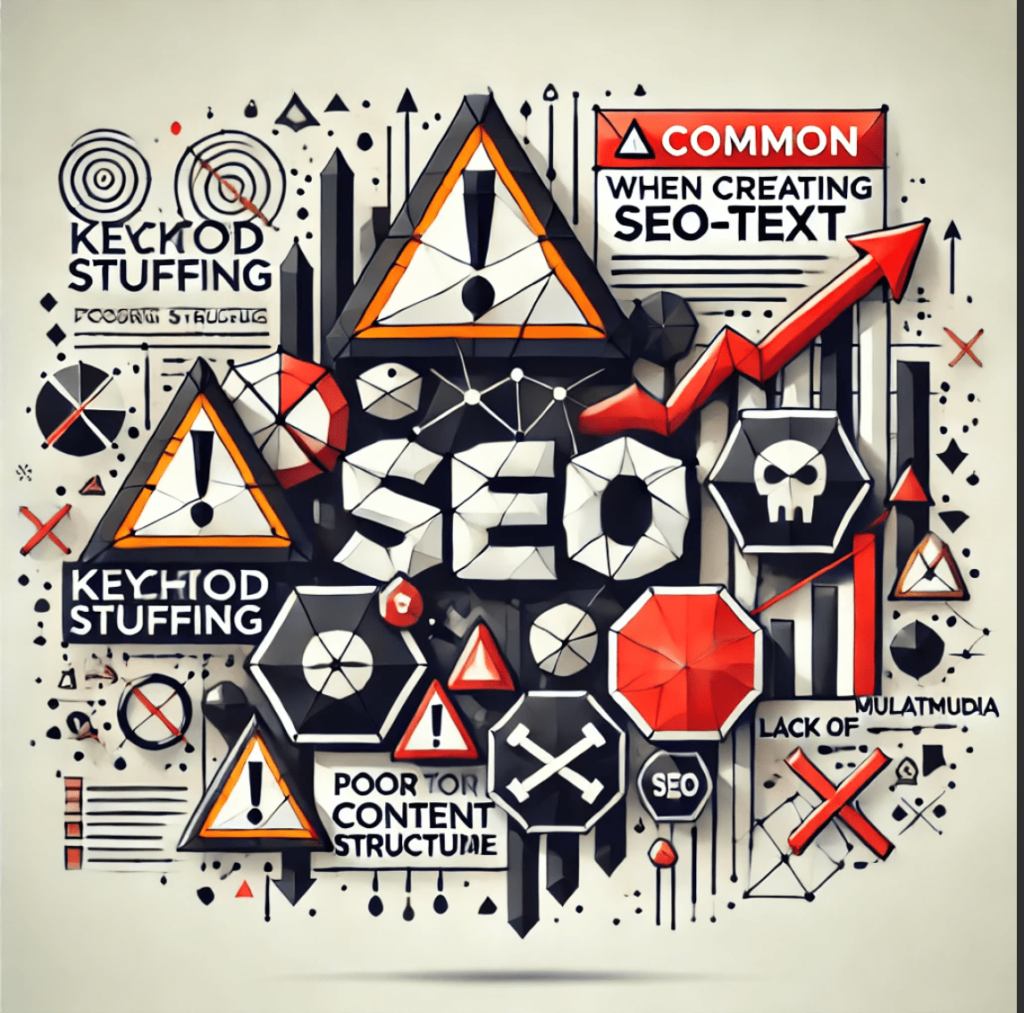
Conclusion
For an SEO text to work effectively, it’s important to consider many factors: proper structure, the skillful use of keywords, adding multimedia elements and up-to-date information, as well as following E-E-A-T principles, which build trust in your content.
Avoid common mistakes such as over-optimization, ignoring user experience, or creating template content — and your website will grow in search results, attracting more and more organic traffic.

Rate the article:





