
86% of consumers do not make a purchase decision without checking reviews and mentions of the company online. This is not just a statistic – it is the reality I face every day working with Ukrainian entrepreneurs and marketers. One negative review that lands on the first page of Google can reduce conversion by 30%, and the lack of information about a brand causes potential customers anxiety and doubt. Have you ever wondered what your future customer sees when they first Google your company name? Are you ready for the fact that people are already talking about you online – regardless of your wishes or control?
I am convinced: a business’s online reputation is not an abstraction, but one of the most valuable business assets. It directly affects sales, loyalty, customer acquisition cost and even the ability to enter new markets. That is why a reputation audit today is not an option but a strategic necessity for any business that strives for growth and long-term success.
In this article I will show how a systematic reputation audit allows you to identify real growth points, manage customer trust and protect the business from reputational risks. If you want not just to “be present” online, but to control your company’s online reputation and use it as a development tool: this article will give you practical solutions and strategic ideas tested by the experience of BUSINESS SITE.
Reputation audit: what it is and why businesses need it?

I view this process as a medical check-up for a business: only by identifying all the “symptoms” can you build an effective treatment and growth strategy.
The objectives of such an audit include:
- Assessing the sentiment of mentions: analyzing the emotional tone of reviews and publications, identifying the predominance of positive, negative or neutral mentions.
- Identifying sources: determining where and who shapes the opinion about the company – review aggregators, industry media, social networks, marketplaces like Prom.ua or Rozetka.
- Analyzing the impact on customer decisions: tracking how reviews and publications affect conversion, repeat purchases, and loyalty.
The most important part: analyzing the dynamics of changes: tracking trends, seasonal spikes of negative or positive sentiment, the emergence of new topics and news hooks. Only in this way can you not just “record” reputation, but manage it proactively.
In BUSINESS SITE practice we use monitoring tools such as Brand24, BrandMentions, LOOQME and Mention. They allow not only collecting mentions in real time, but also building visualizations of dynamics, analyzing sentiment and identifying “white spots” – topics and platforms where the brand is not represented.
This allowed us to adjust the review management strategy and increase the effectiveness of SERM services.
For effective monitoring it is important to understand which data sources to use to analyze online reputation.
Data sources for monitoring online reputation
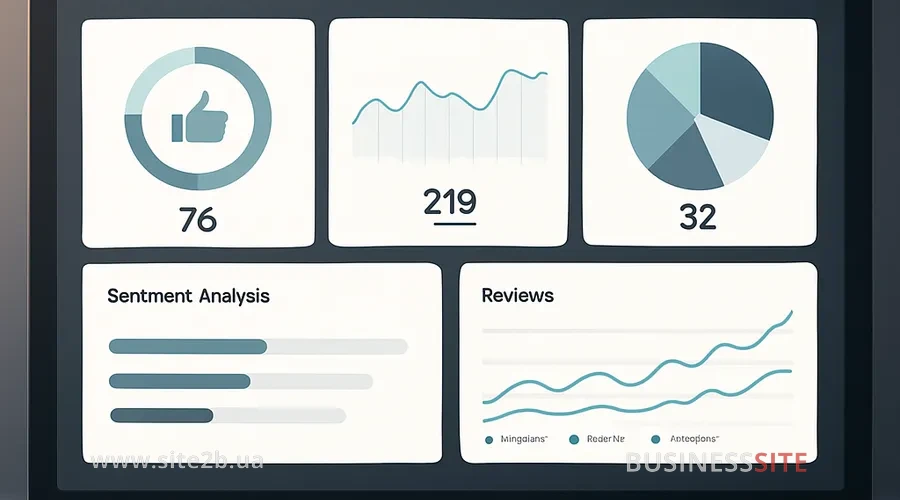
Comprehensive reputation monitoring is impossible without covering all relevant sources. A standard audit includes:
- Google search results: analysis of the first 2-3 pages for brand and product queries, including localization and personalization of results.
- Social networks: Facebook, Instagram, tiktok, LinkedIn, as well as local communities on Telegram and Viber.
- Media and news resources: industry portals, trade publications, blogs.
- Review platforms and aggregators: Google Business Profile, Trustpilot, Rozetka, Prom.ua, Otzovik.
- Marketplaces and delivery services: analysis of reviews and ratings on Prom.ua, Rozetka, “Nova Poshta”.
The Dark Web and closed forums are generally not included in a standard audit due to their limited influence on mass perception and difficulty of access. Nevertheless, when a reputational attack is suspected, the BUSINESS SITE team can connect additional analysis methods.
The key challenge is accounting for the localization of search results and personalization (geolocation, language, search history). For objectivity I recommend:
- Using incognito mode and a VPN to neutralize personal factors.
- Comparing search results from different regions and devices.
- Using independent monitoring services that do not depend on browser history.
This is especially important for companies operating in multiple cities or countries: search results and reviews can vary greatly by region, which affects reputation management strategy.
Do we conduct reputation audit and monitoring every day?

In my experience, a reputation audit is not a one-off action but part of systematic brand work. Reputation is a living organism that changes daily. In crisis situations (for example, during a spike of negativity or a reputational attack) monitoring should be daily, with automatic notifications of new mentions. In stable periods a weekly or monthly analysis is sufficient.
Timely response to new mentions is the key to minimizing risks and maintaining customer trust. This is especially important for sensitive niches (medicine, fintech, educational services), where even a single negative incident can lead to loss of customers and reduced sales.
Reputation audit and monMonitoring: who needs it?
There is no business for which an online reputation wouldn’t matter. However, there are industries where the cost of a mistake is especially high:
- Medical and pharmaceutical companies: negative reviews can undermine trust in the safety and effectiveness of products.
- Financial services and banks: reputation directly affects loyalty and the influx of new clients.
- Legal firms and educational platforms: reputation is the main criterion for most clients when choosing.
- Hotels, restaurants, delivery services, marketplaces: decisions are made based on reviews and ratings on platforms like Google Business Profile, Rozetka, Prom.ua.
For these niches, local reputation audits and systematic monitoring become not just a recommendation but a necessary element of business processes. Reputation here is an asset that affects customer acquisition cost, conversion, and repeat purchases.
How to tell if a business needs a reputation audit?

There are a number of signs that lead me to recommend conducting a reputation audit for a business immediately:
- You don’t know what a user sees when searching for your brand (haven’t Googled yourself in incognito mode for a long time).
- A drop in trust or sales is observed even though marketing activity hasn’t changed.
- Search results and aggregators show an informational “blank space”: no reviews, articles, or mentions.
- Planning to enter a new market or launch a product.
- Suspicions of reputational attacks have appeared: a wave of similar negative reviews, publications on platforms new to you.
Even in the absence of obvious negativity, an audit is useful: often it is precisely the lack of information that makes a customer wary and lowers conversion. For one of the online stores the BUSINESS SITE team worked with, we found that the absence of reviews on Rozetka and Google Business Profile reduced brand trust more than a couple of negative comments.
Reputation audit: stages and methods
A reputation audit is a systematic process of assessing the current state of a company’s image and identifying factors that influence its perception online and in the media. Within this process, key stages and methods are distinguished that help deeply analyze search results and the sentiment of mentions to effectively manage reputation and minimize risks.
Analysis of search results and sentiment
The first step is analyzing the first two to three pages of Google search results for brand and product queries. I pay attention not only to the presence of negativity but also to “white spots”—the absence of official sources, recent news, and expert publications. It is critically important to assess the sentiment of brand mentions: positive, negative, neutral. For this, automated tools and manual checks are used, especially in niches with a high risk of emotionally charged reviews.
The solution we developed at BUSINESS SITE included creating new PR materials and expert articles, which made it possible to push negative content out of Google’s top 10.
Analysis and comparison of competitors by SEO
The next stage is auditing competitors’ reputations. I compare how the main players are represented in search, which platforms and topics they use, where they have “white spots” or growth opportunities. Such competitive analysis in search results allows not just copying others’ successes but building your own strategy: for example, strengthening presence on platforms where competitors are weak or launching image-building articles on topics that interest the target audience.
For one fintech client we found that competitors actively work with reviews on specialized forums and aggregators, which directly affects loyalty and attracting new users. Based on this data, we prepared recommendations to strengthen work with reviews and launch educational content.
Risk assessment and practical recommendations
The final stage is identifying reputational risks and forming a roadmap. I classify problems by criticality: from single negative reviews to systemic reputational attacks. For each risk I develop response scenarios: increasing positive exposure (for example, publishing case studies and testimonials), content updates, working with reviews on key platforms.
For a laboratory operating in a sensitive medical niche, we implemented systematic monitoring and regular publication of expert materials, which made it possible not only to reduce the share of negativity but also to increase trust among new clients.
Thus, a systematic approach to identifying and preventing reputational risks becomes the basis for effective brand management. Let’s move on to practical methods for responding to negativity and building a positive online image.
Responding to negativity and managing online reputation
Before responding to negativity, I always analyze the situation: who is the source, what is the audience, is it an organic crisis or a planned attack. In practice at BUSINESS SITE we use four main strategies:
- Ignoring insignificant mentions that do not gain reach.
- A reasoned response with a proposed solution: especially important for reviews on highly visible platforms (Google Business Profile, Rozetka).
- Removal of clearly fake or rule-violating content (through platform moderation).
- Counteracting negativity with positivity: publishing new case studies, reviews, expert articles.
SERM services (Search Engine Reputation Management) allow systematic management of a company’s online reputation, pushing negative content out of the top search results and shaping a positive information background. For one e-commerce client we implemented a strategy in which each wave of negativity was accompanied by the publication of new case studies and reviews, which allowed us to steadily maintain a high level of trust.
The impact of online reputation on sales and business
The company’s reputation on the internetReputation is the filter through which every potential client passes. Positive reviews, expert articles, activity on social networks and aggregators directly affect conversion and the cost of acquiring a customer. According to international studies, 72% of users trust online reviews as much as personal recommendations.
In BUSINESS SITE’s practice we recorded conversion growth of up to 18% after implementing regular work with reviews and publications on key platforms.
Reputation is not just an “image”, but a real factor that affects financial performance and business competitiveness. For entering new markets, attracting investment, or expanding a partner network, a transparent and positive online reputation becomes a mandatory requirement.
Online reputation for business growth
Reputation: it’s not something you can “put off until later”. It is formed daily, regardless of your control, and works either for your growth or against it. A reputation audit allows you to see the full picture, identify risks and growth opportunities, and systematic monitoring and management ensure long-term trust and stable business growth.
Start controlling your company’s online reputation today so that tomorrow you won’t have to “put out fires”, but can confidently move toward new heights.
Rate the article:





