
Imagine: you launch an ad campaign on Facebook, invest a budget, wait for sales, and the result is disappointment. Familiar? In my experience, more than 60% of Ukrainian entrepreneurs and marketers encounter that even attractive creatives and well-targeted audiences do not deliver the expected ROI. Why? Because without testing we simply don’t know what works and what doesn’t.
At BUSINESS SITE we regularly see how clients who previously relied on intuition or “best practices” increase conversion by 30–50% after implementing split testing of Facebook ads with the same spend. This is not magic, but a rigorous scientific approach. A/B testing – is not just a tool, but a foundation for decision-making in conditions of high competition and a limited budget.
In this article I will explain in detail, how to properly conduct split testing of Facebook ads, which elements to test, how to choose metrics, avoid mistakes and scale successful solutions. You will get not only theory, but also concrete examples from BUSINESS SITE’s practice, as well as step-by-step instructions you can apply immediately in your work.
Why use A/B testing in Facebook advertising?
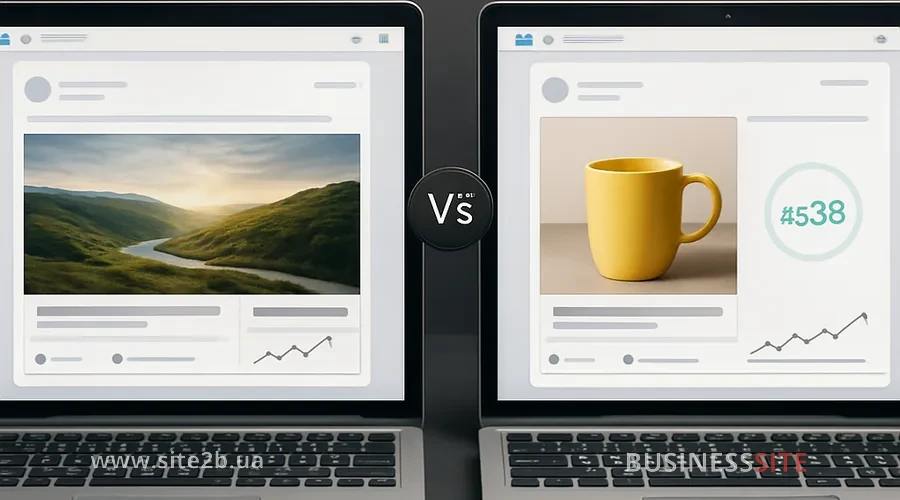
One of the main illusions of digital marketing is the belief that an experienced specialist will always guess which ad will ‘hit’. In reality, even the most creative ideas can fail if they are not tested on a real audience. At BUSINESS SITE we have found that only data and testing allow you to make informed decisions, not guesswork.
A/B testing (or split-testing) is a method in which two versions of the same ad are compared to determine which one is more effective. This approach is especially relevant for Facebook Ads, where ranking algorithms are constantly changing and audiences quickly get tired of repetitive creatives. Oversaturation is a real problem: if you show the same ad for too long, CTR and conversion inevitably decline.
A/B testing — this is not a one-off action, but a process of continuous improvement. Only this way can you fight audience oversaturation, maintain a high CTR and scale successful campaigns.
Which Facebook ad elements to test

The effectiveness of Facebook advertising directly depends on which ad elements you test and optimize: whether it’s creatives, copy, or calls to action. A/B testing allows you to compare different versions of these elements and find those that resonate best with your audience, increasing engagement and conversions. Only this way can you obtain real data instead of relying on assumptions and take your ad campaign to the next level.
Let’s figure it out, how to properly test individual creative elements, images, videos, and copy to get the maximum return from your advertising.
Testing creatives: images, videos, copy
A creative is the face of your ad. It attracts attention and prompts action. At BUSINESS SITE we recommend testing different versions of images, videos, copy and even formats (carousel, collection, stories). Often small changes, for example the color of a button or the presence of text on an image, can produce a significant increase in conversion.
Video is a separate story. In one case for a travel agency we compared a short dynamic video with a classic slideshow. The video produced twice as many clicks to the site, but the slideshow had a higher conversion to inquiries. Conclusion: test different formats, even if it seems like you’ve “tried everything” already.
Testing audiences and placements
An audience is not just “women 25–35”. At BUSINESS SITE we often use custom audiences (Lookalike, retargeting, custom segments) and compare their effectiveness. For example, for a banking product we tested audiences by interests (finance, investments) and by behavior (active Monobank and PrivatBank users). The latter showed better conversion and a lower CPA.
Testing calls to action
CTA (Call to Action) is the final push to act. At BUSINESS SITE we test different options: “Buy now”, “Learn more”, “Submit a request”, “Download price list”. For e-commerce “Buy now” often works, for B2B — “Submit a request”. But this is not an axiom: you should always test on your own audience.
How to conduct an A/B test in Facebook Ads
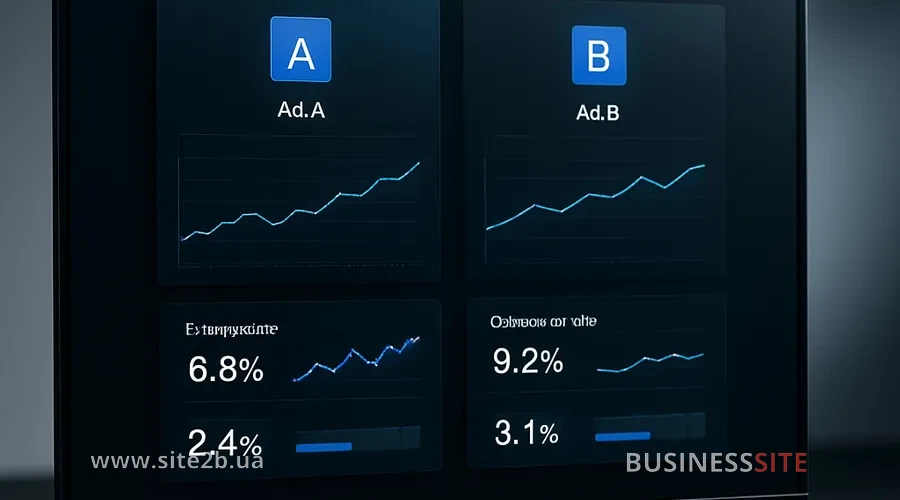
Running an A/B test in Facebook Ads is an effective way to objectively compare different ad variants and understand which one delivers better results. Proper testing starts with a clear formulation of hypotheses and setting specific goals, which help focus on key metrics and obtain the most useful data for optimizing campaigns.
Formulating hypotheses and setting goals
The first step is to clearly state the hypothesis. For example: “An image with a model will produce a higher CTR than an image of the product.” Or: “An audience based on behavior converts better than one based on interests.” Without a hypothesis, a test turns into a chaotic trial of variants.
To assess how effectively these actions produced the desired changes, metrics and KPIs will help.
Metrics and KPIs
Which metrics should you track? CTR (click-through rate), CR (conversion to the desired action), CPA (cost per action), ROAS (return on investment) — it all depends on your business goals. For an online store the key metric is often ROAS, for lead generation — CPA.
Launching the test
Technically, a split test in Facebook Ads Manager is launched through the “Experiments” section. It’s important to duplicate the campaign, change only one element (for example, the image), and keep the other parameters unchanged. It’s best to split the audience randomly to avoid biasing the results.
How to collect and analyze data
After the test ends, you need to analyze the results: compare metrics, check statistical significance (p-value < 0.05), and take into account external factors (weekends, holidays, changes in Facebook’s algorithms). At BUSINESS SITE we use not only Facebook’s built-in analytics but also integration with Google Analytics, CRM, and other tools. To achieve maximum effectiveness, it’s important to implement changes correctly and scale the process.
Implementing changes and scaling the process
If the test showed a significant difference — scale the successful variant. If not — formulate a new hypothesis and launch the next test. Even if an ad performs well, it can still be improved.
How to track the effectiveness of a Facebook split test?
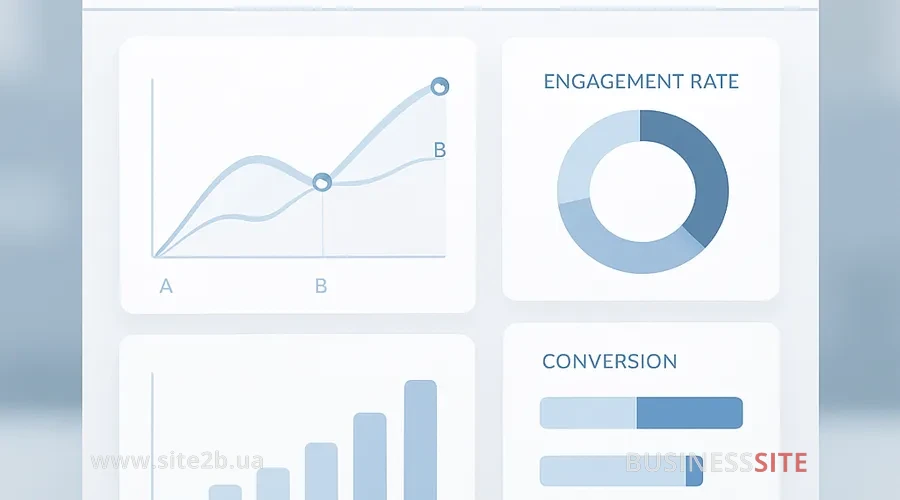
With Facebook split tests, a business can quickly determine which advertising strategies are most effective for their target audience.
CTR: what it is and how it affects website traffic
CTR shows how many users clicked an ad out of those who saw it. A high CTR is a sign that the creative attracts attention. But it’s important to remember: CTR does not always correlate with conversion. At BUSINESS SITE we have seen cases where “clickbait” headlines delivered a high CTR but low conversion to sales.
What is CR (conversion) and how can it be increased?
CR is the percentage of users who completed a target action (purchase, lead, registration). It is a key metric for assessing the real effectiveness of an ad.
What is CPA (Cost Per Action)?
CPA is the cost of a single target action. The lower the CPA, the more efficient the campaign. At BUSINESS SITE we always compare the CPA of different ad variants and choose the one that delivers the best result for the same spend.
ROAS in advertising: meaning and calculation
ROAS: return on ad spend. This is the main metric for e-commerce and other businesses where direct monetization of traffic is important.
Setting up split tests in Facebook Ads Manager

- Create a duplicate of the campaign in Ads Manager.
- Change only one element (creative, text, audience, placement).
- Set equal budget distribution between variants.
- Launch the campaigns simultaneously for a clean experiment.
- Use the «Experiments» tool for automatic split testing and result analysis.
- Set up automatic test completion when statistical significance is reached.
- Analyze the results and make changes to the main campaign.
Split-testing mistakes in Facebook advertising
Split-testing Facebook ads is a powerful tool for optimizing ad campaigns, allowing you to compare different ad variants and choose the most effective. However, split-testing mistakes can lead to inaccurate results and inefficient budget spending.
Common mistakes marketers make
- Testing multiple variables at the same time. If you change the creative, the copy, and the audience, it’s impossible to know what exactly affected the result.
- Ending the test prematurely. Insufficient data leads to false conclusions.
- Sampling bias. If audiences overlap or are distributed unevenly, the results will be incorrect.
- Ignoring external factors. Holidays, algorithm changes, competition: all of these can affect test results.
How to avoid data distortion
- Randomize the audience. Use Facebook’s built-in tools to evenly distribute traffic.
- Consider placement and timing. Run tests under the same conditions.
- Collect a sufficient volume of data. For statistically significant results you need at least 100–200 conversions per variant.
- Run repeat tests. Sometimes results can vary depending on season or other factors.
Limitations of tools and methodology
- You can’t test everything at once. Multilevel (multivariate) testing is possible, but it requires large budgets and complex analysis.
- Integration with other tools. Facebook Ads Manager doesn’t always give the full picture: use third-party analytics.
- Audience saturation. Even successful creatives lose effectiveness over time: they need to be refreshed.
How to scale advertising through split testing
Split testing is not a one-off action, but part of a long-term marketing strategy. At BUSINESS SITE we implement regular testing for all key campaigns of our clients. This allows not only to find the best solutions, but also to quickly respond to changes in the market and audience behavior.
Another important aspect: scaling successful solutions. If a test shows that a particular creative or audience performs better, you can increase the budget for that variant, expand the geography, or apply that finding in other campaigns.
Conclusion
A/B testing of Facebook ads — not a luxury but a necessity for any business that wants to achieve maximum efficiency from its advertising budgets. Only data and a systematic approach allow you to make informed decisions, avoid mistakes, and scale successful campaigns.
Article questions
Q&A on split-testing in Facebook Ads:
-
How does split-testing in Facebook help increase the ROI of an ad campaign?
It allows you to identify the most effective creatives, audiences, and strategies, which reduces spend on ineffective ads and increases return on investment. -
Which performance metrics are most important for evaluating A/B tests in Facebook?
CTR (click-through rate), CR (conversion rate), CPA (cost per action), ROAS (return on ad spend). -
How to correctly formulate hypotheses for split-tests in Facebook to obtain relevant data?
Clearly define the variable and the expected result, for example: “Changing the image will increase CTR by 15%.” -
How to avoid mistakes when allocating audiences in Facebook split-tests?
Use Facebook’s automatic distribution, ensuring audiences do not overlap between variants. -
Which ad elements in Facebook should be tested first for maximum effect?
Creative (image/video), headline, text, call to action, audience. -
How long should you run a split-test in Facebook for results to be statistically significant?
Usually 3–14 days — until sufficient data volume and significance level are reached (typically 95%). -
What risks and limitations exist when scaling results from split-testing in Facebook?
Results may not hold after changing budget, audience, or season; it’s important to retest when scaling. -
How to account for time of day and placement influence on Facebook split-test results?
Run the test under the same time conditions and include the same placements for both variants. -
How to integrate Facebook split-test results with the company’s overall marketing strategy?
Use successful insights to optimize content, targeting, and other advertising channels. -
Which Facebook Ads Manager and Marketing API tools are best suited for setting up and analyzing split-tests?
The “Experiments” tool (Experiments Tool) in Ads Manager and the Facebook Marketing API for automation and deep analytics. -
How does split-testing help combat audience saturation and declining ad effectiveness?
It allows regularly refreshing creatives and finding new variations that maintain audience interest. -
Which A/B testing practices and methodologies should be applied for long-term improvement of Facebook ad campaigns?
Continuous testing, one variable at a time, sufficient sample size, fixed test duration, and analysis of statistical significance. -
How to evaluate and interpret CTR, CR, CPA and ROAS metrics in the context of Facebook split-tests?
- CTR — creative effectiveness;
- CR — traffic conversion rate;
- CPA — cost-effectiveness of actions;
- ROAS — overall financial result.
-
Is it possible to test multiple elements simultaneously in Facebook A/B tests without distorting results?
No, it’s better to test one element at a time; for multiple changes use multivariate testing.
Rate the article:





