
The Question about Digital Marketing
In this article, I will dissect internet marketing: explaining why it is not just a fashionable trend but a key to competitiveness, profit, and sustainable development. I will share practices that the BUSINESS SITE team applies for clients from various industries in Ukraine and tell you how to avoid typical mistakes, choose effective tools, build a team, and control the results. If you want practical strategies rather than theory, read to the end: here are the best solutions tried and tested.
Internet Marketing for Business

In 2025, a digital strategy is not just a set of tools but a systematic approach that integrates the company’s marketing, operational, and service processes. For example, for a pharma company that the BUSINESS SITE team worked with, implementing an omnichannel digital funnel allowed them to reduce the deal cycle by 30% and increase lead conversion to sales. Such results were possible thanks to the competent integration of digital promotion channels, end-to-end analytics, and communication automation.
Types of Internet Marketing

Internet marketing is developing in different directions, each solving its own tasks and requiring a specific approach. Some focus on quick lead generation, some on building brand recognition, and some combine both approaches. To achieve the maximum effect from digital promotion, it is important to understand the differences between key types of marketing. Let’s take a closer look at three main directions: performance, brand, and brandformance marketing.
Performance Marketing – Lead Generation and Quick Sales

Performance marketing is about measurable results: applications, orders, calls, registrations. The key tools of internet marketing here are contextual advertising (Google Ads), targeted advertising on social networks, CPA marketing (cost per action), retargeting. The main task is to build a digital funnel where each stage is transparently measured.
In working with an e-commerce project, the BUSINESS SITE team implemented digital lead generation automation: linked CRM with ad accounts, set up end-to-end analytics, which allowed tracking the ROI of internet marketing by channel and optimizing the budget in real-time. Key metrics for performance marketing: Cost Per Lead (CPL), conversion, ROI, LTV, digital funnel depth. This approach ensures transparency and manageability of digital campaigns.
Brand Marketing – Building Trust and Long-Term Value

Brand marketing is responsible for recognition, trust, and audience loyalty. Important tools here include content marketing, SMM promotion, influencer marketing, video marketing, online reputation management. For B2B companies, the customer journey map plays a special role, allowing personalized digital communications at each stage.
According to BUSINESS SITE observations, systematic work with content (expert articles, cases, webinars) and SMM promotion allow not only maintaining audience attention but also forming the long-term value of the brand. Brand marketing metrics: reach, engagement, recognition, sentiment analysis, dynamics of mentions in the digital environment.
Brandformance Marketing – Synergy of Sales and Brand
Brandformance marketing combines the best practices of performance and brand marketing. This approach is especially effective for companies that want not only to sell quickly but also to build a sustainable brand. For example, for a construction company, BUSINESS SITE implemented an omnichannel digital strategy: targeted advertising generated leads, while campaigns for building an expert image and managing digital reputation were conducted simultaneously. The result was increased sales and enhanced trust in the brand.
Stages of Internet Marketing Management
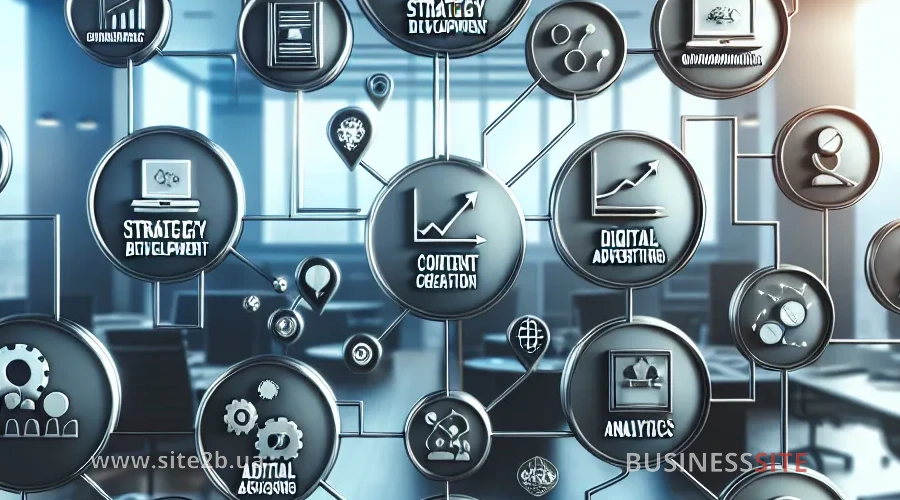
Building an effective digital strategy requires a systematic approach and precise tuning at each stage. From market analysis to assessing results — each step affects the success of internet marketing. It is important not only to choose tools but to build a holistic strategy that considers business goals, audience behavior, and the specifics of digital channels. Let’s look at the key stages that make up a successful digital strategy.
Marketing Research
Any effective digital strategy starts with a deep analysis: market, competitors, target audience, product. Use of big data, customer development, segmentation of the digital audience, and tools that allow identifying the real needs and pain points of clients.
In BUSINESS SITE practice, online marketing research includes analysis of search queries, social media monitoring, surveys through services like Google Forms, and work with crm data. Such data-driven marketing ensures the relevance of digital communications and minimizes risks when launching new digital campaigns.
Development of Digital Strategy
At this stage, goals (SMART) are formulated, and digital promotion channels (SEO, contextual advertising, SMM, email marketing, influencer marketing, etc.) are selected, building a digital sales funnel. It is important to consider market specifics: the optimal set of channels may differ for B2B and B2C companies.
The BUSINESS SITE team uses customer journey mapping for building a digital funnel, which allows precisely identifying touchpoints and selecting tools for each stage. For example, for market entry, we recommend testing digital channels through A/B testing and pilot campaigns to minimize budget risks.
Implementation and Automation of Internet Marketing
Implementation of MarTech solutions (CRM, chatbots, email automation, end-to-end analytics) allows not just launching digital campaigns but managing them in real time. Automation of internet marketing saves time and resources, increases the accuracy of personalization, and accelerates scaling.
In one project for the financial sector, BUSINESS SITE specialists integrated chatbots for marketing and email automation, increasing conversion to application by 25%. Agile marketing and flexible management of the digital team ensure a quick adaptation to market changes and maximum return from the digital strategy.
Evaluation of Effectiveness in Digital Marketing
Control of the effectiveness of digital campaigns is built on clear KPIs: cost per lead, conversion, ROI, LTV, dynamics of the digital funnel. End-to-end analytics and digital reporting allow seeing the real picture and making data-driven decisions, rather than relying on intuition.
Digital Marketing Tools

The choice of digital marketing tools directly affects the effectiveness of a digital strategy and achieving business goals. Each channel—from SEO promotion to chatbots—has its own task: attracting traffic, engaging the audience, increasing conversion, or strengthening loyalty.
It is important not just to use popular tools but to adapt them to the niche specifics and campaign goals. Below we consider the key digital marketing tools that prove their effectiveness in BUSINESS SITE projects.
Contextual Advertising and Website Search Optimization
Contextual advertising (Google Ads) and search optimization (SEO) are basic tools for attracting traffic. In 2025, optimizing multimedia content, voice search, and implementing artificial intelligence for big data analysis and SEO automation gain special significance.
Practice at BUSINESS SITE confirms: the integration of SEO and PPC allows you to quickly get applications and simultaneously increase organic traffic. It is important to regularly audit content, optimize metadata, develop a link profile, and use programmatic advertising to enhance the effectiveness of digital campaigns.
SMM Promotion and Marketing on Social Media
SMM promotion: it’s not just publishing but also working with communities, video marketing, quiz marketing, managing digital reputation. In Ukraine, key platforms are Facebook, Instagram, TikTok, LinkedIn, and for e-commerce: integration with marketplaces like Prom.ua and Rozetka.
BUSINESS SITE specialists use SMM for lead generation, reviewing work, and launching omnichannel campaigns. Video content and user-generated content (UGC) help keep attention and increase audience engagement.
Content Marketing and Email Marketing
Content marketing is expert articles, cases, infographics, podcasts, videos. Personalized email newsletters and automation of email marketing allow building long-term relationships and increasing a client’s LTV.
For a laboratory in the pharmaceutical sector, the BUSINESS SITE team implemented email marketing automation with digital audience segmentation, increasing email open rates by 40% and reducing the cost of repeat sales. Key metrics: engagement, CTR, conversion, base dynamics.
Innovative Digital Channels
Influencer marketing, chatbots, CPA marketing, omnichannel campaigns are growth drivers in the digital ecosystem. For the Ukrainian market, especially relevant are integrations with local delivery services (“Nova Poshta”), payment solutions (“PrivatBank”, “Monobank”).
The Profession of Internet Marketer in 2025

The profession of an internet marketer in 2025 requires much more than knowledge of ad accounts and basic promotion tools. It is a strategic role, combining analytics, project management, technological literacy, and leadership qualities. In the context of rapid digital environment development, it is important for specialists not only to possess current skills but also to be able to adapt quickly to changes. Below, we will discuss what competencies an internet marketer should have today and what prospects this profession opens up.
What Skills are Needed for an Internet Marketer?
A modern internet marketer is not just a specialist in advertising. It is important to be able to analyze data (digital analytics, BI systems), manage projects (Agile, Scrum), budget digital campaigns, and build interaction with contractors and IT departments.
How Much Does an Internet Marketer Earn
Internet marketers’ salaries in Ukraine range from the junior level to digital director and directly depend on expertise, specialization, and business scale. In large companies, digital strategists, and managers earn 2-3 times more than generalists in small businesses. Income growth is possible through qualification enhancement, mastering new digital channels, and managing digital teams.
How to Develop in Internet Marketing?
Digital marketing is a field where learning never ends. New tools, trends, and approaches such as artificial intelligence, marketing automation (MarTech), big data, personalization, and omnichannel digital funnels emerge each year.
For constant development, I recommend using international courses (Coursera, Udemy, LinkedIn Learning), specialized blogs and reports (HubSpot, Gartner, eMarketer), industry conferences, and communities. It is important not just to study digital marketing trends but to integrate them into practice: test, analyze, scale successful solutions.
The BUSINESS SITE team regularly implements innovations, such as end-to-end analytics automation, CRM and digital channel integration, agile marketing, personalized digital communications for B2B and B2C. This approach allows us not only to keep up with the market but also to outpace competitors.
Conclusions

Internet marketing is not just a set of digital tools but a strategic system that determines a company’s success in the digital era. A systematic approach, deep expertise, continuous learning, and innovation adoption enable businesses to grow, scale, and minimize risks. BUSINESS SITE practice confirms: a digital strategy based on the synergy of performance and brand marketing, data-driven analytics, and automation ensures measurable profit growth and sustainable development.
Rate the article:





