
Why does this happen? Because the textual relevance of a page is not just a formality for search engines, but the foundation of trust between a business and its customer. In the digital environment, text becomes the main communication tool that creates the first impression, answers questions, persuades, and sells.
How to check a page’s relevance? How to properly draft a technical brief for a copywriter? Which tools and methods truly work for checking and correcting text? I suggest we examine these issues systematically and thoroughly so that every executive, marketer, or entrepreneur can confidently manage the quality of their texts and achieve measurable results. Read on, and you will receive not only answers but practical solutions proven by BUSINESS SITE’s experience.
What is relevant SEO text on a page?
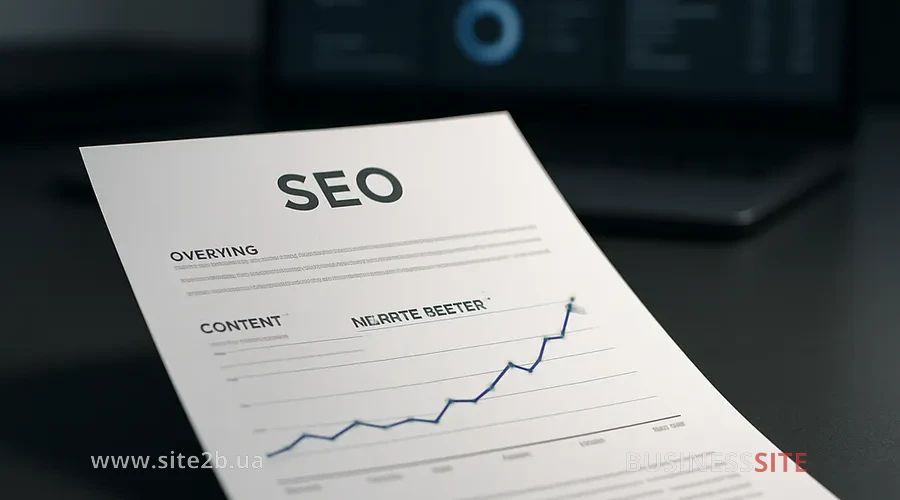
The textual relevance of a page is the degree to which the page’s content matches a specific search query.
Context and topical relevance: this is what distinguishes an expert SEO text from a formal set of keywords. For example, for an online electronics store it is not enough to simply mention «buy a smartphone»: it is important to highlight advantages, compare models, describe delivery conditions via «Nova Poshta» or payment via «PrivatBank», so that the text is as useful and relevant to the user’s query as possible.
Signs of Poor SEO Text and Its Impact on Business

Signs of low-quality SEO text can seriously affect how a business is perceived and how effective it is online. Mistakes in content and presentation not only lower a site’s rankings in search results, but also worsen user trust, which ultimately impacts a company’s profitability. Let’s look at the main mistakes when writing commercial copy and their consequences for business.
Common Mistakes in Commercial Texts
Over the years I have identified a number of common mistakes that appear in commercial texts and significantly reduce their effectiveness:
- Lack of meaningful content: Text “for the sake of text”: when pages are filled with generic phrases that do not reveal the essence of the offer. This approach is common among companies that treat SEO as a formality.
- Stylistic and semantic mismatches: For example, using terms that are not typical for the target audience, or absurd constructions that confuse readers.
- Overstuffing with keywords: The urge to “please” search engines leads to texts becoming unreadable, and the site risks falling under SEO filters and penalties.
Consequences of Poor Text for Conversion
- Decreased trust and user retention: According to statistics, more than 70% of users leave a site if the text seems low-quality or irrelevant to them.
- Loss of positions in search results: Google’s algorithms and those of other search engines actively fight low-quality and over-optimized content, lowering the rankings of such pages or removing them from the index altogether.
- Drop in site conversion: Even if a user found the site, poor text does not convince them to take the desired action, place an order, submit a request, or subscribe.
How to write a technical specification for a text
A technical specification is a document that ensures full mutual understanding between the client and the copywriter about the requirements for an SEO text. A correctly drafted technical specification guarantees that the author will create content that meets all optimization parameters and solves specific business tasks. A detailed description of the structure, keywords, target audience and other criteria makes it possible to receive a text that already shows ranking growth in search engines upon its first indexing.
Main components of a technical specification for a copywriter
A properly prepared technical specification for a text is the key to creating relevant and effective content. At BUSINESS SITE we always include the following elements in the specification:
- SEO keyword selection: We use both exact and LSI words to expand the semantic core and increase the page’s relevance.
- Determining the text length: We base it on competitor analysis and search engine requirements. For commercial pages the optimal length: from 2000 to 5000 characters, for expert articles – from 8000.
- Creating a thesis plan and structure: We clearly specify headings, subheadings, and main content blocks so the copywriter understands the logic of the presentation.
- SEO text uniqueness requirements: At least 95% according to uniqueness checking services to avoid plagiarism and duplication.
- Additional parameters: Indication of the target audience, tone, examples of competitors, requirements for meta tags and internal linking.
How to avoid keyword stuffing
Over-saturation with keywords is one of the most common problems I encounter when auditing texts. To maintain the balance between optimization and naturalness, BUSINESS SITE specialists recommend:
- Focus on keyword density: Optimal is 1–2% for main keywords, 2–3% for LSI words.
- Use stop-words and synonyms: This helps make the text more natural and avoid “spam”.
- Embed keywords organically: Keywords should be part of meaningful constructions, not inserted mechanically.
- Check the text for “nausea”: For this we use special tools that analyze the repetition of words and phrases.
How to check the relevance of a text
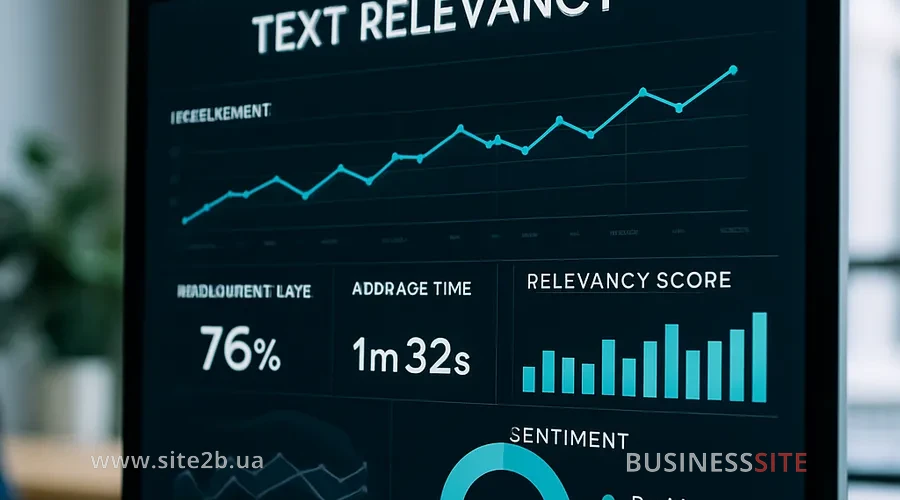
Methods for checking textual relevance and SEO text help ensure that content truly answers users’ queries and meets search engine requirements. One of the first steps is to check the thesis outline and compliance with the technical specification, to lay the proper foundation for further optimization.
Checking the plan against the technical specification
The first stage of the check: comparing the finished text with the technical specification. I always recommend:
- Check for the presence of all key blocks and theses: The text should fully reveal the stated structure.
- Compare the actual occurrence of keywords with the plan: We use tables to control the distribution of keywords and LSI terms.
- Assess the completeness of topic coverage: If any block is covered superficially, we return the text for revision.
Checking text uniqueness: an overview of tools
To assess text uniqueness we use several services:
- Serpstat: Allows not only to analyze uniqueness but also to detect duplication of fragments, which is critical for online stores and large portals.
- Plagiarismdetector.net and Duplichecker: Suitable for quick checks of individual texts, they show the percentage of uniqueness and sources of matches.
- Criteria for choosing a service: We take into account the depth of analysis, checking speed, availability of reports, and support for the Ukrainian language.
Analysis of keywords and LSI in the text
For analyzing keywords and LSI we use:
- ISTIO: This tool allows identifying all keywords and LSI terms in the text, assessing their distribution and density.
- Methods for selecting LSI words: We use Google search suggestions, analyze the top 10 competitors via Serpstat, and form thematic clusters.
- The importance of LSI for relevance: LSI words expand the text’s semantics, make it more «human» and expert, which positively affects ranking.
Text editing and best practices for proofreading

Proofreading plays a key role in SEO, providing not only correctness but also alignment with the brand voice. Best editing practices help make content readable and relevant for both users and search engines.
The importance of proofreading for readability and brand voice
Proofreading is the final, yet no less important stage. I am convinced that even a text perfect in structure and keywords can “fail” if it is unreadable or does not match the brand voice. At BUSINESS SITE we always:
- Check style and avoid bureaucratic jargon: Excessive turns of phrase and complex constructions reduce comprehension.
- Adapt the text to the target audience: For B2B – a business style, for e-commerce – conciseness and simplicity.
- Control readability: We use Flesch-Kincaid formulas and equivalents for the Ukrainian language.
Tools for proofreading text
To improve text quality I recommend:
- Grammarly: Great for checking grammar, punctuation, and style, especially for English-language projects.
- Hemingway App: Helps simplify complex sentences, increase readability, and remove “fluff”.
- Languagetool: A universal tool for checking texts in different languages, including Ukrainian.
Tips for editing text for SEO
- Use active verbs: They make the text dynamic and engaging.
- Avoid clichés and bureaucratic jargon: Replace them with simple and clear phrasing.
- Check complex words and anglicisms: Keep only those that truly add value.
- Contextually check every phrase: The text should be logical and consistent, without “fluff” and excessive repetition.
The impact of text relevance on conversion and site ranking
Text relevance directly affects trust and user retention. According to our analytical reports, pages with high relevance show:
- Conversion growth of 30–50%: Users find the information they need faster and take the desired action.
- Improved behavioral metrics: Bounce rate decreases, average time on site increases.
- Higher rankings in search results: Modern search engine algorithms evaluate not only the presence of keywords, but also the depth of topic coverage, structure, uniqueness and usefulness of content.
How to create and check text for SEO
My experience and practice at BUSINESS SITE show: only a comprehensive approach to creating, checking, and refining SEO text allows achieving maximum page relevance, improving its positions in search results, and ensuring conversion growth.
Questions about the article
- How does textual relevance affect a site’s rankings in search results? Relevant text increases the page’s match to the search query, improves ranking, and raises the likelihood of reaching the top.
- What methods for checking text relevance are most effective for business? Keyword analysis, comparison with competitors in the top 10, checking via TF-IDF/SEO auditors, and evaluation of behavioral metrics.
- How to assess whether the text matches the target audience’s queries? Compare the structure and content of the text with user intents, analyze engagement, depth of view, and user feedback.
- What risks are associated with keyword stuffing in the text? Drops in rankings due to over-optimization, reduced readability, diminished trust, and possible search engine penalties.
- How to adjust the text to increase the site’s conversion? Strengthen the structure, improve offers, add micro-CTAs, simplify phrasing, and adapt the text to the user’s real needs.
- Which tools are best to use for checking uniqueness and relevance? Serpstat, Ahrefs, SEMrush, PageOptimizer Pro, Copywritely, Text.ru, ContentWatch.
- How to build a technical brief for a copywriter taking SEO requirements into account? Specify keywords, intents, structure, volume, style, competitor examples, and requirements for metrics (uniqueness, relevance, readability).
- How to scale a content strategy without losing relevance quality? Use templates, a content guideline, a unified tone of voice, automation of SEO checks, and multi-level editorial review.
- Which relevance metrics are important for evaluating content marketing ROI? Organic traffic, keyword rankings, depth of view, conversion, CTR, time on page and cost per lead.
- How to avoid stylistic mistakes and inconsistencies in commercial copy? Use editing, a brand tone guide, checks via grammar services, and a final multi-level Quality Check.
Rate the article:





