In 2025, 80% of websites lose traffic due to outdated SEO strategies that do not meet Google’s new requirements and changed user behavior. This fact raises the question: why do some companies continue to receive a steady stream of customers from search while others lose positions and budgets? I often hear from entrepreneurs and marketers: “Why does advertising not bring the expected results, and organic search is becoming increasingly unpredictable?” The answer is hidden not only in content, but also in how the classification of links is built and how wisely their potential is used for SEO ranking.
At BUSINESS SITE we regularly face tasks where the correct handling of links becomes a growth point for business: be it a pharmaceutical company, an online store, or a construction firm. How links are classified and placed affects not only rankings, but also traffic stability, conversion, and most importantly – return on investment (ROI).
In this article I will examine in detail the typology of SEO links, their impact on site structure and business results, and will also share strategies that we implemented at BUSINESS SITE for clients from various industries. If your goal is transparent, measurable results and reliable risk management, I recommend reading the material to the end: here you will find practical solutions that work in Ukrainian realities.
Classification of SEO links and their role in promotion
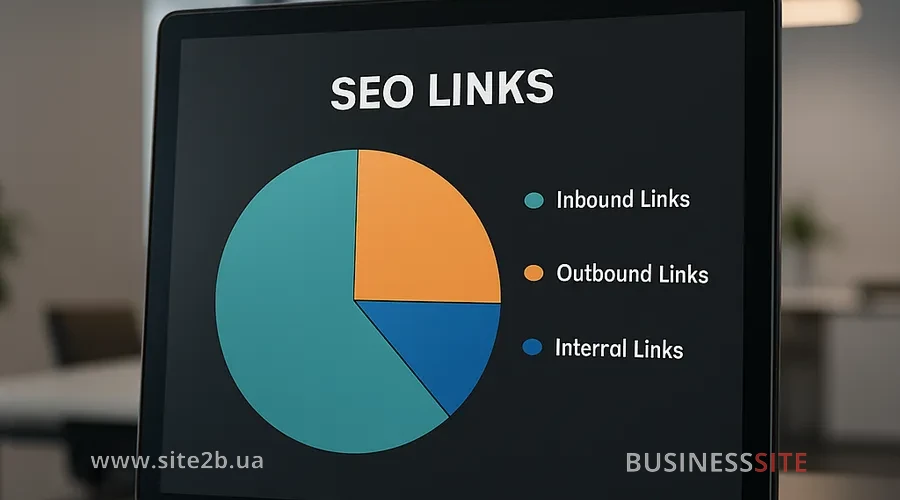
Link classification is the foundation for building a quality link profile and an effective SEO strategy. In my experience, it is the understanding of link types that allows entrepreneurs and marketers to manage risks, forecast results, and build long-term growth strategies.
Internal and external links in SEO: specifics and impact
Internal links are connections between pages of the same site. They are responsible for distributing link juice, help search bots index the structure, reinforce important sections, and improve user experience. For example, for an e-commerce project we at BUSINESS SITE implemented advanced internal linking between categories and product pages, which allowed us to increase the depth of browsing and accelerate the indexing of new pages.
external links (backlinks) lead from other sites to your resource. They are the main source of authority and trust for search engines. Quality external links from niche platforms, media, or thematic blogs can significantly improve rankings and traffic.
I recommend using internal links to strengthen key pages and create a logical architecture, and external links to grow authority and attract new audiences. It’s important to monitor the quality of donors and avoid links from irrelevant or low-authority sites.
Now let’s consider how anchor and anchorless links affect SEO.
Anchor and anchorless links for SEO
Anchor text: this is the visible part of the link that the user clicks to go to another page. Optimizing the anchor profile is critical for SEO: search engines analyze how well the anchor matches the page topic and use it to determine relevance.
In BUSINESS SITE practice we found that keyword over-spamming in anchors leads to Google sanctions and ranking drops. It is recommended to use diverse anchors: branded, thematic, combined and anchorless (for example, “here”, “read more”). Anchorless links look natural and help form a safe profile.
For business it’s important to balance the anchor profile: avoid uniform commercial anchor texts, distribute them across different types of pages, and use LSI phrases that reveal the topic without directly repeating keywords.
Permanent and rented links for SEO: what matters?
Permanent (permanent) links are placed on a site until it exists or the material is removed. They provide stable authority growth and a long-term SEO effect. In the case of a construction company we achieved steady ranking growth thanks to permanent links from niche directories and blogs.
Rented (temporary) links are bought for a limited time (month, quarter). They can deliver quick results but carry risks: after the rental ends, rankings often fall, and abrupt removal of links can trigger search engine sanctions.
I recommend using permanent links for strategic pages, and rented links only for short-term campaigns, carefully monitoring dynamics and preparing backup options in case of removal.
Placing links in content, the footer, and on the homepage for SEO
Links placed in main content (text, articles, reviews) pass the maximum link juice and are perceived by search engines as natural. At BUSINESS SITE we noted that links in expert materials and blogs lead to growth in targeted traffic and conversions.
Technical links in the footer and sidebar have less value, especially if there are many and they repeat on every page. We recommend using such links for navigation, contacts, and legal information.
Links from the homepage carry special weight: they distribute link weight among the main sections of the site, strengthen the internal structure and help new pagesbe indexed faster.
Link attributes dofollow, nofollow, sponsored and UGC in SEO
Dofollow links pass link juice and affect ranking. They should be used for trusted and relevant donors.
Nofollow links do not pass link weight directly, but can attract traffic and look natural in the profile. BUSINESS SITE recommends adding nofollow to links from forums, comments and promotional materials.
Sponsored and UGC (User Generated Content) attributes are used to denote paid and user links. This helps search engines distinguish natural links from promotional ones and minimize the risk of penalties.
Proper use of attributes allows managing the transfer of link weight and maintaining a natural profile, especially when working with crowd marketing and guest posts.
Influence of links on SEO – factors and quality assessment
Search engines evaluate links by a number of factors that determine their impact on SEO ranking. At BUSINESS SITE we regularly analyze:
- Domain authority (Domain Authority) – the higher the metric, the more link juice a link passes.
- Relevance of the donor site – topical relevance increases the value of the link.
- Quality of the content around the link: links in expert materials, reviews and analytics work better than in spammy comments.
- Anchor text: a relevant, diverse anchor strengthens the SEO effect.
Before buying or placing a link I advise evaluating the donor site by metrics: Domain Authority (Moz), Trust Flow (Majestic), PageRank (Google), as well as analyzing traffic, audience activity and the absence of penalties.
Link profile quality metrics
For monitoring and analyzing the link profile at BUSINESS SITE we use:
- Ahrefs – tracking new and lost links, analysis of the anchor profile.
- SEMrush – domain authority assessment, identification of toxic links.
- Majestic – analysis of Trust Flow and Citation Flow.
- Google Search Console – checking external and internal links, identifying issues.
Key metrics: number of quality links, diversity of donors, naturalness of link growth, absence of sharp spikes and drops.
Internal links and distribution of link weight

Properly structured internal linking allows strengthening important sections, speeding up the indexing of new pages and optimizing the site structure for users and search engines.
In the ecommerce case we implemented an internal linking scheme between categories, filters and product pages, which increased average time on site and depth of browsing by 24%. For large projects I recommend scaling the strategy using automatic linking modules, and also analyzing the structure through visual site maps.
Optimizing the anchor texts of internal links helps search engines better understand the topics of sections and strengthen their relevance.
Strategies for acquiring natural and artificial links

Natural links: mentions of your site on other resources without direct intervention. They are valued by search engines and provide long-term growth in rankings. In BUSINESS SITE practice we achieved natural link growth through publishing expert materials, PR activities and participation in industry events.
Artificial SEO links: placements initiated by the site owner: purchase, exchange, placement in directories. They can accelerate growth but carry the risk of Google penalties, especially if the profile looks unnatural.
I recommend building a strategy based on balance: focus on natural links, and use artificial ones selectively, with careful donor verification and gradual mass increase.
Methods for building a link profile: crowd, guest posts, outreach
Crowd marketing: placing links in discussions, forums, comments. This helps attract targeted traffic and form a natural profile. In the BUSINESS SITE lab case, crowd marketing was used on specialized medical forums, which brought an influx of qualified leads.
Guest posts and outreach: publishing expert materials on authoritative platforms. This is not only a source of quality links but also a way to strengthen the brand, increase reach and gain a target audience.
PR and media mentions: links from news resources, interviews, reviews by opinion leaders. Such links have maximum authority and often lead to increased trust from search engines.
Managing risks and ROI of links: paid, free, barter
performance evaluation of paid links involves analysis of ranking growth, traffic and conversions. At BUSINESS SITE we calculate ROI for each campaign, taking into account the cost of the link, the increase in organic traffic and the LTV of acquired customers.
A balance between paid, free and barter links allows minimizing risks and maintaining a natural profile. For example, for a bank we combined guest posts, crowd marketing and barter placements, which provided stable growth without penalties.
I advise avoiding rapid link mass build-up, monitoring dynamics and regularly auditing the profile through Ahrefs or SEMrush.
Link quality and management of link mass for SEO

In my view, link quality is always more important than quantity. A proper classification of links, understanding their types and strategic management of the link profile: this is the foundation of steady website growth, search engine trust, and transparent business results.
The practice of BUSINESS SITE confirms: the combination of internal and external links, a balance of natural and controlled methods, regular audits and optimization of the anchor profile: these are the tools that allow entrepreneurs and marketers to reach goals, save time and resources, and most importantly — build a sustainable business amid Google’s constantly changing algorithms.
In 2025, SEO is not simply a set of techniques, but a comprehensive strategy where every link works for your results. And it is precisely the strategic approach to link classification and their impact on SEO ranking that becomes a competitive advantage for businesses aiming for growth and long-term success.
Rate the article: