
80% of advertising campaigns in google ads lose up to a third of their budget due to keyword overlap and ineffective negative keyword management; this is data from recent international studies on PPC optimization. I regularly encounter this in projects at BUSINESS SITE: entrepreneurs and marketers invest in advertising but get irrelevant clicks instead of meaningful results — a waste of budget.
Working with the semantic core is often perceived as a routine, monotonous task. Still, modern services, Telegram bots and tools based on artificial intelligence can turn the process into a manageable and strategically advantageous part of digital marketing. I am convinced: competent cross-exclusion in Google Ads is not just a technical trick, but a tool for increasing ROI, CTR and conversions. In this article I will show how the BUSINESS SITE team solves cross-exclusion tasks for clients from the pharmaceutical, e-commerce, banking and construction sectors, and which services actually work on the Ukrainian market.
If you want to understand how to optimize advertising campaigns, avoid budget loss and achieve measurable results: I recommend reading the article to the end. Here you’ll find only proven methods, practical case studies and strategic ideas that can be implemented immediately.
Cross-negative keyword exclusion in Google Ads
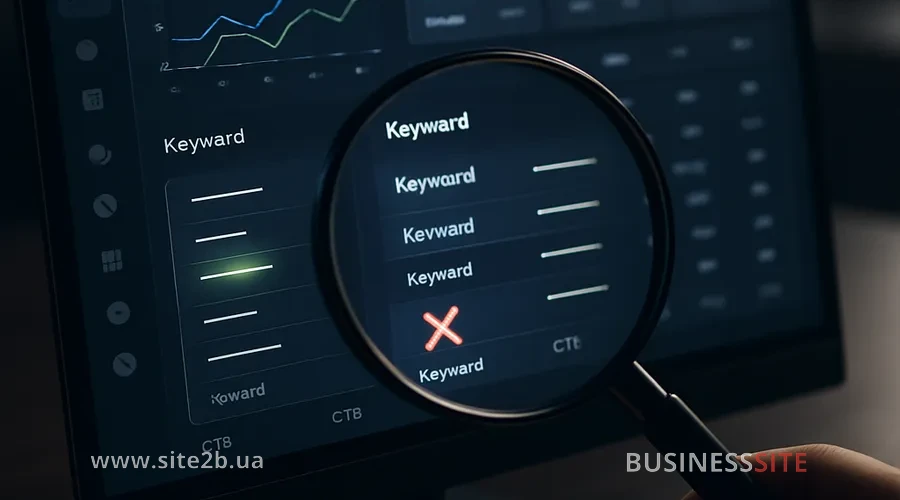
Cross-negative keyword exclusion in Google Ads is the process of adding negative keywords (negative keywords) to prevent cross-competition between ad groups and keyword phrases. Simply put, it is a way to ensure that each ad is shown only for the most relevant queries, eliminating overlaps and duplication.
Risks and Pitfalls of Cross-Negative Keyword Exclusion: How to Avoid Traffic Loss

Cross-negative keyword exclusion: a powerful tool, but its use requires caution and a strategic approach. The main risk is a drop in impressions, especially when working with low-frequency queries. If you add negative keywords too early or incorrectly, you can lose relevant impressions and miss potential customers.
It is important to analyze campaign structure, keyword match types (broad, phrase, exact, negative) and regularly monitor performance metrics: CTR, ROI, conversion, CPA. I recommend using Google Analytics and third-party BI systems to track changes after implementing cross-negative matching.
Manual negative keywording of ad groups in Google Ads

Manual cross-negative keywording: the optimal choice for small accounts, niche products and situations that require maximum precision. I believe this method is especially effective when working with a SKAG structure (Single Keyword Ad Group) and thematic groups.
Step-by-step instruction that we use in BUSINESS SITE:
- Export keywords and ad groups from Google Ads Editor to Google Sheets.
- Analyze overlaps between groups using formulas and filters.
- Add negative keywords with the Negative Exact match type to each group to exclude overlapping queries.
- Import the updated data back into Google Ads Editor.
- Verify the correctness of changes and test ads for relevance.
However, when working with large data sets this method becomes time-consuming. In such cases I recommend moving to automation, which I will describe below.
Cross-negative keyword exclusion with AI: capabilities and limitations

Artificial intelligence: a powerful tool for automating routine tasks in ppc, including cross-negative keyword exclusion. В BUSINESS SITE мы тестировали различные решения на базе ChatGPT и других NLP models для генерации минус-слов и анализа семантики.
- Fast processing of large datasets.
- Generating ideas for negative keywords based on the analysis of search trends and behavioral factors.
- Ability to integrate with the Google Ads API and CRM systems.
I am convinced that AI is a tool to speed up work, but not a replacement for expert oversight. В BUSINESS SITE мы используем ИИ для первичного сбора семантики и генерации идей, но финальное решение всегда принимает специалист, анализируя результаты и проверяя соответствие бизнес-целям.
Automating cross-negative keyword exclusion via the Shema Telegram bot
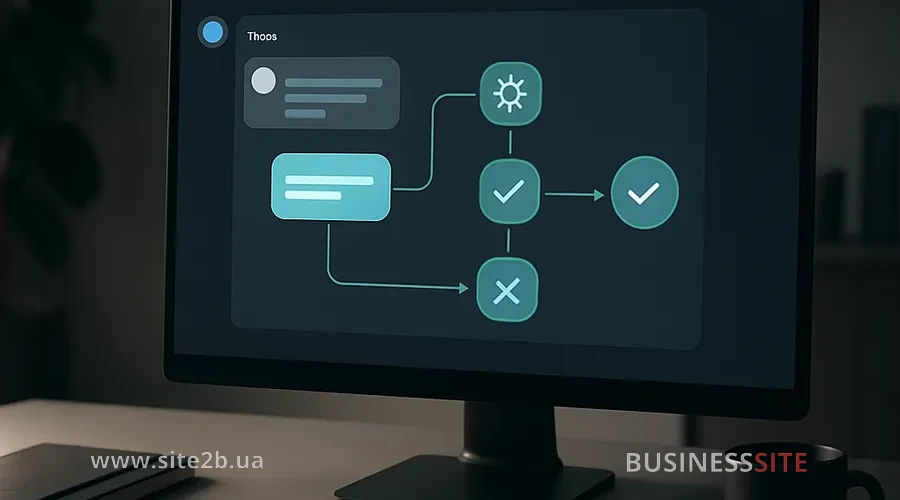
Telegram-бот Shema_cross_minus, один из самых удобных сервисов для автоматической кросс-минусовки на украинском рынке. Его алгоритм учитывает словоформы, структуру групп и позволяет быстро обработать большие массивы ключевых слов.
How the process works:
- Data preparation: export of keywords and ad groups from Google Ads Editor.
- Uploading the file to the Telegram bot.
- Receiving the finished file with negative keywords, distributed across groups taking intersections into account.
- Importing the results back into Google Ads Editor.
- Manual review and adjustment, if required.
Optimization of cross-negative matching in Google Ads
Effective cross-negative matching requires combining manual and automated methods. I recommend:
- Regularly analyze semantics and adjust negative keywords based on A/B testing results of ads.
- Use automation services to process large datasets, but always perform expert review.
- Monitor key metrics: CTR, ROI, conversion, CPA: and respond to changes after implementing cross-negative matching.
- Avoid traffic cannibalization between ad groups, especially when scaling campaigns.
- Integrate cross-negative matching with analytics systems (Google Analytics, Power BI) for in-depth performance assessment.
- Implement automation of routine tasks through chatbots, APIs and third-party services to save time and resources.
Cross-negative keyword exclusion in Google Ads: ad optimization
Cross-negative keyword exclusion in Google Ads is not just a technical setting but a strategic tool for improving advertising effectiveness. I am convinced: a combination of automation, expert oversight and regular metric analysis is the key to success for any advertising campaign.
Q&A on cross-negative matching in advertising:
It increases ROI by eliminating competition between keywords and optimizing budget allocation toward the most relevant queries.
Errors can lead to lost traffic, reduced reach and the exclusion of relevant queries from impressions.
Use automated scripts, APIs or specialized services, as well as regular reports on key conflicts.
Direct Commander, Elama, K50, Aori, eL-Tools and in-house scripts via Google Ads Scripts or Yandex Direct API.
Clearly separate keywords and use negative keywords between groups so that each query leads to a single ad.
It increases the relevance of impressions, which improves click quality and raises conversions by matching user intent more precisely.
Add it to the campaign optimization stage — regularly update negative keyword lists when analyzing search queries.
CTR, CPC, conversions, CPA, share of impressions for relevant queries and the level of keyword overlap.
Use automated rules, scripts and reports integrated with analytics (Google Sheets, Power BI, API).
Excessive addition of negative keywords, lack of relevance checks, keyword duplication and ignoring search query reports.
Rate the article:





