
A vague terms of reference leads to unclear expectations, conflicts between the client and the contractor, and most importantly — to loss of time and money.
This article is a detailed guide on how to prepare a technical specification for website development. I will explain how the BUSINESS SITE team approaches this process, what mistakes we have encountered in practice, and what tools actually work in the Ukrainian market.
What is a technical specification for website development?
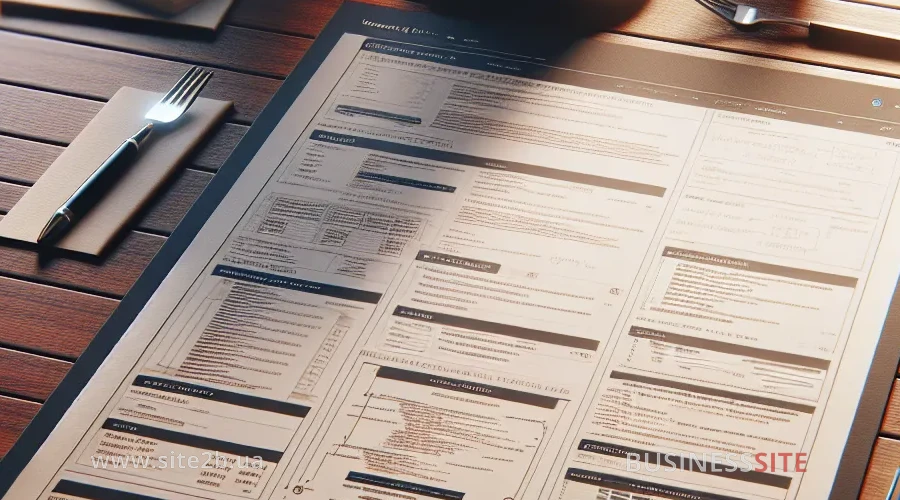
Essentially, it is a “roadmap” for all participants in the process: client, developer, designer, content manager. At BUSINESS SITE, we always emphasize that the technical specification is not just a formality but a key tool for managing expectations and quality control.
A well-crafted technical specification allows you to accurately determine what outcome you want to achieve, which KPIs are important for assessing success, and how interaction with the contractor will take place. For instance, in one of our projects for a major Ukrainian marketplace, we detailed not only the standard pages but also the integration scenarios with “Nova Poshta” and online payment via “PrivatBank” in the specification.
Main components of the technical specification structure

Website goals and objectives
The first and most crucial step is to define the goals and objectives of the website. Without this, it is impossible to build an effective structure and choose the right tools. In the technical specification, we always outline for whom the site is being created (target audience), what it should accomplish (e.g., attracting new clients, increasing brand awareness, generating leads), and which metrics will be indicators of success.
Functional requirements for the website
Here it is essential to describe in detail what functions the website should perform. For example, for creating a catalog website, we usually include:
- A content management system (CMS) with an easy-to-use editor;
- The ability to publish articles, news, case studies;
- Categorization and tags for articles;
- Catalog search;
- Comment modules (with moderation options);
- Integrations with CRM, email campaigns, analytics services;
- Connecting feedback forms, newsletter subscriptions;
- Integration with Ukrainian delivery services (“Nova Poshta”), payment systems (“PrivatBank”, “Monobank”), if necessary when developing an online store;
- Responsive design for mobile devices.
Don’t forget about utility pages: 404, privacy policy, information about delivery and payment if the site is related to sales.
UX/UI design in the technical specification
UX/UI design is not only about “beauty” but also about user convenience. In the technical specification, we necessarily describe design requirements: brand colors, fonts, button styles, logo requirements, adaptability. If the company has a brandbook, it’s great; it should be attached to the technical specification. If not, we help to form basic guidelines. It’s important to define user scenarios beforehand: how a visitor will search for articles, how to subscribe, and how to share materials on social media. Prototypes (wireframes) of the main and typical pages are a mandatory attachment to the technical specification, even if they are just simple diagrams.
The process of composing a technical specification for web development

- We analyze the client’s business processes and goals.
- We describe the target audience, their pains, and needs.
- We form the site structure: a list of pages, their hierarchy, functionality.
- We detail requirements for design, functionality, integrations.
- We define security and SEO requirements.
- We approve prototypes and user scenarios.
- We record all details in a single document signed by both parties.
From experience, I can highlight several best practices:
- Use the most understandable and unambiguous language. All terms and abbreviations should be deciphered.
- Provide specific examples of websites that you like or dislike, with an explanation of why.
- Specify who is responsible for providing and approving content.
- Prescribe user action scenarios: what happens when you click a button, how filtering works, how requests are processed.
- Include checklists and tables for task completion control.
- Agree on the technical specification in stages, especially if the project is complex and multi-level.
What questions to ask the developer when composing a technical specification

- What CMS and technologies will be used and why?
- How will user data security be ensured?
- How is integration with external services (delivery, payment, analytics) implemented?
- Who and how will fill the site with content?
- What are the deadlines and stages of project delivery?
- How will support and site updates be organized after launch?
- What metrics and reports will be available for analyzing the site’s effectiveness?
Internal SEO optimization and content strategies in the technical specification

SEO promotion — is not an option, but an essential part of a successful website. In the technical specification, we always include requirements for internal SEO optimization:
- User-friendly URLs (human-readable URLs);
- The ability to edit meta tags (title, description, keywords);
- Generation of sitemap.xml and robots.txt;
- Setting up micro-markup for articles;
- Performance and page load optimization;
- Integration with Google Analytics, Google Search Console, as well as Ukrainian analytics systems if applicable.
It’s important to determine the semantic core and the site category structure in advance to avoid redoing the architecture after the launch.
The role of content strategy in the technical specification

Content strategy is not only about what to write but also how, for whom, and with what frequency. In the technical specification, we fix:
- The topic and sections of the site;
- Content formats (articles, interviews, case studies, videos);
- Requirements for uniqueness and tone of materials;
- The procedure for content approval and publication;
- Responsible persons for filling and updating the site.
Business goals in the technical specification

Web development for business is always a tool for achieving specific goals: increasing sales, growing loyalty, automating processes. In the technical specification, we always fix business metrics: the number of requests, growth of subscribers, the conversion rate from visitor to client. For e-commerce projects — integration with marketplaces (Prom.ua, Rozetka), automation of order processing via “Nova Poshta” API or payment solutions “PrivatBank”. It is important that each site function is tied to a specific business task.
Tools and methodologies for composing a technical specification
Agile methodologies and other approaches
In recent years, we have increasingly applied flexible project management methodologies: Agile, Scrum, Kanban. They allow you to break the project into short sprints, quickly respond to changes and adjust the technical specification during work.
This approach is especially effective for complex and long-term projects where requirements may change as new information becomes available.
Tools for creating and managing a technical specification

- Google Docs and Notion — for collaborative work and versioning of documents;
- Figma — for prototyping and design approval;
- Jira and Trello — for task management and execution control;
- Miro — for visualizing user scenarios and site architecture.
For Ukrainian clients, it is important that services are available and support integration with local solutions (e.g., API “Nova Poshta” or “PrivatBank”).
Examples of successful technical specifications for website development

At BUSINESS SITE, we always emphasize practice.
- The site structure: main page, categories, article cards, tag filters;
- Integration with CRM and email campaigns;
- SEO requirements (URL structure, micro-markup, adaptability);
- The procedure for content publication and moderation;
- Instructions for data security and backup;
- Prototypes of all key pages;
- Clear KPIs: a 30% increase in organic traffic within 6 months, a 20% increase in the number of subscribers.
The result — the project was completed on time, without reworks and additional costs, and the client received a transparent content management system and measurable results already in the first months after the launch. You can see the example of the technical specification via the link>>>
Conclusion

A well-crafted technical specification for website development is not just a formal document, but a strategic tool that helps the business achieve its goals, save time and budget, and most importantly — get predictable and quality results.
I believe that every entrepreneur, marketer, or manager should start the process of creating a website precisely with the development of a technical specification. If you are unsure where to start — the BUSINESS SITE team is always ready to help you go through this path, using our experience, best practices, and modern tools. Start with the technical specification — and your project will definitely be successful!
Rate the article:





