
When I first started in web development and internet marketing, many entrepreneurs in Ukraine believed that SEO was something global, complex, and expensive. However, over the past few years, the situation has changed drastically: today, local SEO has become one of the key tools for promoting a business in a specific city. Why? More than 70% of Ukrainian users search for goods and services through Google, adding the city or district name to their query. According to our partner studies, about 80% of such local searches end with a visit to an offline location or a call to the company within a day.
At BUSINESS SITE, we face questions daily from small and medium business owners: how not to lose money on advertising, how to ensure that clients find them instead of their competitors, and how to measure the efficiency of their marketing investments. In this article, I will explain in detail how local SEO works, what tools and strategies are effective in Ukraine, and how to avoid typical mistakes that lead to budget and time loss.
What is Local SEO and Who Is It For

If your business is oriented towards the local market — for example, you own a coffee shop, car service, dental clinic, fitness club, or retail store — local SEO is essential for you. Even if you operate nationwide but have pickup points (“Nova Poshta”, own warehouses, showrooms), it’s important that every branch is visible in searches for its city.
The key task is not just to get into the top of search results, but to attract the exact audience that is currently looking for your services or products in your city. In our projects, we often encounter large companies that underestimate the importance of local queries, losing up to 40% of potential clients due to the lack of geo-targeted optimization.
Algorithms of Local Search Results

In 2025, Google’s algorithms became even more sensitive to local signals. The search engine takes into account not only classic SEO factors (content relevance, link quality) but also parameters like the accuracy and consistency of NAP (Name, Address, Phone Number), the presence of reviews, activity on local maps, and even brand mentions in local media. This means that to successfully promote a business in a city, it’s not enough just to create a website — you need to build an entire ecosystem of local presence.
For example, in 2025, Google enhanced the influence of reviews and local links on the ranking of companies in Google Maps. This means that working with reviews and local partnerships has become an integral part of a successful strategy.
Preparing for Local Promotion

Before launching a local SEO campaign, it’s important to conduct an audit of your business’s current position in local search. We are often approached by companies that do not appear on the Google map or rank low for key local queries. The reasons can vary: absence of a Google My Business card, incorrect contact data, lack of reviews, weak local content.
One effective method is to analyze which keywords clients use to find your business and compare this data with competitors.
Creating a Local SEO Strategy

The strategy starts with choosing the right keywords. It’s important to consider not only main queries (“laptop repair Kyiv”) but also long-tail ones (“laptop repair with on-site service Kyiv Poznyaki”). At BUSINESS SITE we always perform keyword clustering: dividing them into groups by district, services, client types. This allows us to create targeted landing pages and increase the site’s relevance for different audience segments.
For example, with the query “cafe center of Lviv,” you can quickly get into the TOP if you optimize the page and company card correctly.
Site Optimization for Local Search
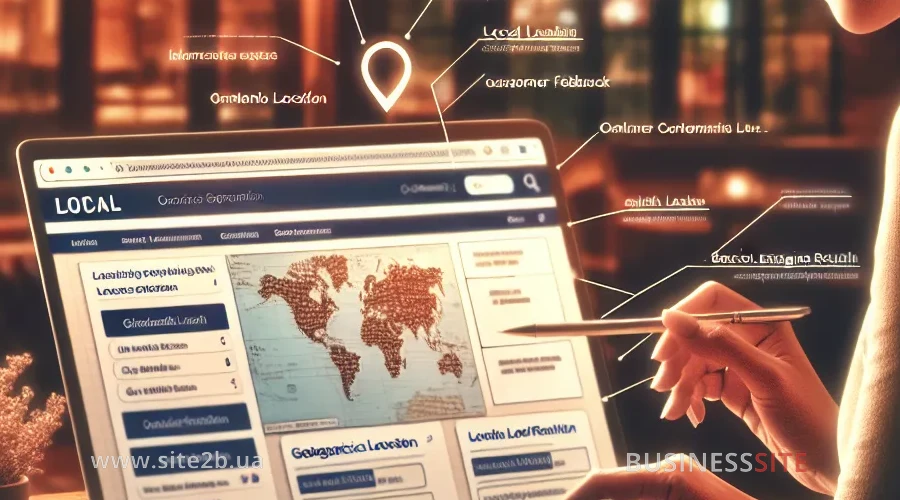
After collecting semantics, it’s essential to implement local keywords into the title tags, descriptions, headings, and main site content. Be sure to add geotags, specify the exact address, phone number, working hours, and other NAP data.
Don’t forget the role of reviews: positive reviews not only increase client trust but also directly affect ranking in Google Maps. At BUSINESS SITE, we implement automatic review collection systems by integrating them with CRM and popular messengers to make the process as simple as possible for the client and effective for the business.
Tools and Platforms for Local SEO

Google My Business and Its Optimization
The Google My Business card is your main tool for local promotion. It allows you to manage company information, post news, respond to reviews, and track statistics. It’s important to fill out all the card fields: from descriptions to photos and website links. Regularly update information, respond to reviews, add new services, and promotions. In one of our cases for a dental network in Kyiv, we increased the number of calls by 35% in three months solely through competent Google My Business optimization and active review work.
Don’t forget about Google Maps: the more high-quality photos, detailed descriptions, and fresh reviews you have, the higher the chance of getting into the top local results. Google Search Console and Google Analytics help track which queries bring users to the site and how they interact with your business after searching.
Alternative Platforms and Their Importance
Bing Maps and Yelp can bring additional traffic, especially if you are targeting an international audience or working in the tourism sector. Registering and optimizing your profile on these platforms takes little time but allows you to expand your reach and increase brand trust.
In the Ukrainian context, it’s also worth paying attention to local business directories, such as marketplaces like Prom.ua, Rozetka, and city service catalogs and directories. Presence in such sources increases the number of local citations and brand mentions, which positively affects SEO.
Conclusion

In practice, at BUSINESS SITE, we see that even small changes — adding an exact address, working with reviews, optimizing the Google My Business card — can lead to a significant increase in traffic and inquiries within the first few months.
Practical Recommendations:
- Conduct an audit of local presence: check how your business appears on Google, marketplaces, and local directories.
- Collect and cluster geo-targeted keywords.
- Optimize your website and Google My Business card, paying special attention to reviews and NAP data.
- Use local links and partnerships to increase authority.
- Regularly analyze results through Google Analytics and Search Console.
In modern conditions, local marketing is not only about SEO, but also working with social networks, local events, integration with delivery services (“Nova Poshta”) and payment solutions (“PrivatBank”, “Monobank”). The more communication channels you use, the higher your chances to attract and retain a customer.
At BUSINESS SITE, we not only implement local SEO but also build long-term partnerships, helping businesses grow and adapt to new market demands.
Rate the article:





