
62% of users buy more often when they see prices and content in their own language, and organic traffic in the EU is distributed unevenly across locales and reacts sharply to URL structure. I have repeatedly observed how a single decision, subfolders vs subdomains, changed indexing rate and CTR by region by as much as 20–35% within about 2–3 months after release. This is not about “cosmetics” but about a demand-ownership strategy: for Europe 2026 the right choice affects brand trust, indexing speed and customer acquisition cost (CAC) in each locale.
In my experience, a site’s multilingual setup for the EU succeeds where the technical architecture, content localization and payment-logistics chains work as a single system. The BUSINESS SITE team on projects in pharma, fintech and eCommerce has seen how the correct choice between subfolders and subdomains sets the foundation for everything: from hreflang for Europe to stable Core Web Vitals across locales.
I think it’s important to set the scope up front: in this article I provide clear criteria for choosing URL structure, a ready migration checklist, technical examples and control metrics. If you plan to enter the EU or already run a multilingual site for Europe, I recommend reading to the end — you’ll get a clear strategy and tactical steps without guesswork.
Europe 2026: subfolders and exceptions

My basic choice for international SEO 2026 in the EU – subfolders. Subfolders (example.com/de/, example.com/fr/) accumulate domain authority, simplify management of canonicals and sitemaps, speed up the transfer of link equity and usually give a better start for organic traffic with identical content and link profile. For teams with centralized responsibility subfolders provide a predictable release cycle and a stable ROI for localization.
In some fintech and pharma cases in our practice, subdomains have proven useful thanks to separate consent banners and different cookie notice policies under ePrivacy, as well as for audit reasons.
Consider the risks and trade-offs: impact on crawling, distribution of domain authority, complexity of caching strategy for subdomains/subfolders, separate handling of cookies/sessions and separate SSL. BUSINESS SITE practice confirms: subfolders more often win on time-to-value and manageability, while subdomains are useful when isolation is important.
Subdomains or subfolders for multilingual sites
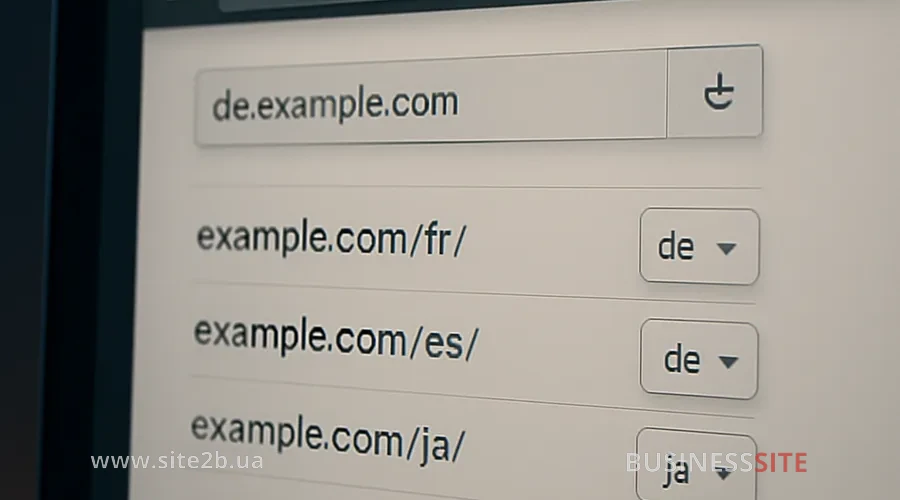
With subdomains you need to promote each zone separately, which increases requirements for the link strategy and content depth at the level of each host.
Geotargeting is configured in google search console and Bing Webmaster Tools for each entity: subfolders use a single domain property with a clearly structured map of locales, while subdomains will require separate properties and, often, separate logging. Geo DNS and IP geolocation are suitable for personalization, but they should not be used to hide content from bots: for SEO, stable URLs and correct rel=alternate hreflang are more important. In production I prefer explicit URL routing: example.com/de/ and example.com/fr/ versus de.example.com and fr.example.com.
Migrating to subfolders often increases visibility. In our observations, when migrating from a subdomain to a subfolder organic traffic for a locale can grow by 10–30% over 8–12 weeks with correct 301s and preserved content. Major risks include loss of signal pages or breaking hreflang; we address this through a strict migration plan and post-release monitoring of bot logs.
Advantages of subfolders for SEO
Subfolders help optimize the crawl budget. Bots crawl a single site more efficiently without index bloat caused by multilingualism when robots and sitemap prioritization are properly configured. I recommend adding update frequency and priorities in XML at the locale level, and also excluding technical and filter pages via noindex and parameterization.
From a UX perspective, subfolders often win thanks to a single authorization profile, shared carts, and a cross-locale user account. On eCommerce projects the BUSINESS SITE team has seen CR increases of 6–12% with a unified cart and a currency/language switcher without changing the domain, especially in the cross-border delivery segment via “Nova Poshta” and local carriers in the EU.
Disadvantages and limitations of subdomains
Subdomains fragment domain authority and require a separate link strategy for each region. Managing cookies and sessions is harder: cross-domain login, consents and ePrivacy banners complicate implementation and maintenance. CDN caching and the caching strategy for subdomains also require separate configuration, which increases the cost of ownership.
Administration becomes more complex: separate SSL certificates, separate GSC properties, separate filters in analytics and a different geotargeting process. Subdomains are justified when a project needs legal data isolation or product independence, for example in the case of a financial service with unique country-specific KYC processes. In such an architecture geotargeting and subdomains work as a deliberate strategy, not as a compromise.
hreflang for Europe: configuration and errors

The rel=alternate hreflang technology tells search engines which language/region versions correspond to each other. Implementation options: tags in the head, sitemap hreflang XML and HTTP headers for media/files. For Europe I recommend maintaining full language-country pairs: en-GB, en-IE, fr-FR, fr-BE, de-DE, es-ES, etc., and adding x-default to the language selector or the international version.
hreflang: tags, sitemap or HTTP
For subdomains the syntax is identical, only the hosts change. The advantage of the approach is clarity and proximity to the content; the downside: difficulty of maintenance with a large number of locales.
Switching from subdomain to subfolder: SEO plan

A successful migration starts with an inventory of URLs and creating a 1:1 matrix. I recommend the stages: preparation (URL map, content parity, hreflang pairs), configuring 301 redirects for the SEO migration, testing on staging and a limited production rollout, then monitoring logs and GSC. The BUSINESS SITE team follows the “no surprises” rule: every redirect is documented, every target is verified.
We minimize risks through automated full-crawl tests, checking the sitemap hreflang XML and comparing indexing statuses in GSC by locale. In the post stage we monitor Impressions/CTR by locale, crawl rate and the number of indexed pages, as well as ranking stability for the core.
A rollback plan is useful when KPIs exceed predefined thresholds. I keep a ready rollback for critical templates, discuss it with marketing, content and partner support teams to maintain the SLA. Such discipline provides peace of mind and preserves trust in the project.
Redirect and canonicalization settings
The 301 strategy includes direct URL mappings without intermediate steps or “language hops”. Redirects are configured at the server level, load-tested and validated with crawling tools; for SPA the server render and status return are additionally checked. Rel=canonical between locales should point to the locale itself, not to the “main” international version, to avoid cannibalization.
This mechanism reduces index bloat and guarantees that each locale accumulates relevant signals.
Localization and UX for European markets

Proper localization is not just translation. Tone of voice, date and address formats, units of measurement, payment methods, logistics and returns — everything is adapted by country. For Ukrainian companies entering the EU, we regularly include checkout localization: EU VAT, PSD2 rules, local payment solutions alongside «ПриватБанк», «Монобанк» and LiqPay, and integrations for international shipping together with «Новой Поштой» and European carriers.
I am a proponent of A/B testing creatives and localized UX by region, and in preproduction we apply pseudo-localization and LQA to check string lengths and cultural nuances.
Content strategy for multiregional markets
Centralized vs localized content strategy: a key management choice. The centralized model, supported by glossaries and a style guide, provides consistent quality and speed of scaling; the localized model brings market insights and flexibility for promo campaigns. At BUSINESS SITE we often use a hybrid: a single terminological framework, translation memory (TM) and local thematic «overlays».
TMS, neural translation and MTPE for websites
Among translation management systems (TMS) in Europe, Smartling, Lokalise, Phrase, Transifex and Crowdin have performed well. Selection criteria include the quality of integrations with your stack (headless CMS, Git, CI/CD), support for glossaries, translation memory, the role of LQA and in-country review (ICR), as well as SLAs for data security and GDPR compliance. I recommend running a pilot on a single locale before scaling.
Integrating the TMS into CI/CD allows releasing locales in sync with development. We configure automatic extraction of source content, an MTPE pipeline, LQA and publishing upon merging the release branch. This approach maintains pace without overloading the team.
TMS integration and the localization workflow
The workflow looks like this: source content goes into the TMS, then passes through MT/PE, after which LQA and, if necessary, ICR are performed, followed by release and metric monitoring. Each iteration enriches the TM to reduce cost and speed up subsequent releases. Pseudolocalization is run on UI components to detect overflows and issues with RTL or special typography.
Server hosting and CDN in Europe
Performance and geo-distribution, the foundation of Core Web Vitals across locales. A CDN with edge localization reduces TTFB and helps maintain good CLS/LCP metrics regardless of country. I prefer a hybrid: centralized hosting with regional edge nodes and a clear caching policy.
Geo DNS and IP geolocation are suitable for selecting the nearest node and personalization, but locale content should have a stable URL. Sessions are best stored so that cross-locale navigation via subfolders does not require re-authentication. GDPR affects provider choice and data storage regions; this should be considered already at the architecture stage.
CDN, cache and Edge functions patterns
For subfolders, caching is easier to standardize: cache-control rules apply to the common domain with variations by locale. For subdomains, an independent CDN configuration is used with separate invalidation and update policies, which increases complexity but provides flexibility. Edge functions help perform lightweight localization: inserting local banners, currency and the nearest shipping option without changing the canonical.
How to preserve SEO when doing i18n in SPA/SSR/SSG
React/Next.js, Nuxt and Gatsby allow combining i18n with SEO if SSR, SSG and dynamic rendering are configured correctly. I use SSR or SSG for critical pages and prerendering for catalogs so that bots receive fully formed HTML. This is especially important for React SSR SEO, where client-side rendering can be delayed for a bot.
SEO setup when working with frameworks
The checklist includes: prerendering of key templates, correct canonical, full hreflang pairs, a sitemap and hreflang sitemap, robots, and schema.org per locale. Add tests that compare server and client renders and track tag desynchronization. Lighthouse and Core Web Vitals monitoring by country help maintain quality after releases.
It’s useful to run dynamic tests that emulate Accept-Language headers and check language negotiation without changing the URL. Such a test prevents “accidental” content swapping for bots.
GDPR and ePrivacy when localizing in the EU
TMS and third-party services must comply with GDPR, especially if they process user data. We check data flows, storage locations, and access permissions to avoid the risk of deviating from policies. Such an audit saves resources and reduces the regulatory burden on the team.
Localization ROI and KPIs after launch
I recommend monitoring organic traffic uplift in Europe, CTR and CR by locales, LTV and CAC, as well as return on investment in translation (localization ROI). The effect of URL structure can be separated from content through phased releases and A/B methodology, setting control groups by locale. The report for management shows payback timelines, cost per word of localization and forecasted LTV uplift to make investment decisions.
x-default, canonicalization and sitemap
x-default serves as a safe “fallback” for users with an unknown locale and directs them to the language selector. Canonicalization between locales requires rules: each locale points its canonical to itself, and language-country pairs are linked via hreflang without a “main” canonical. This prevents cannibalization and preserves relevance.
Sitemap hreflang XML should be generated automatically and validated at build time to avoid omissions and mismatches. Crawl budget management includes priorities in the sitemap, noindex for auxiliary pages, and URL parameter optimization. This set of measures keeps the index in a “dry” state and speeds up indexing of important pages.
Pre-launch checklist and audit template
Before migration, make sure the URL strategy is approved, TMS integration is ready, hreflang is checked, SSL and CDN are configured, and legal requirements are accounted for. At launch, monitor redirects, canonical, GSC monitoring, analytics and LQA so quality doesn’t drop. After launch, monitor traffic, rankings, indexing errors, UX metrics and financial KPIs to confirm the business impact.
Task template for the technical team
Goal: migration `de.example.com` to `example.com/de/` without loss of indexing. Scope: 100% of URLs, 301 direct mappings, rel=canonical updated, rel=alternate hreflang updated, sitemap hreflang XML generated, GSC properties updated and errors checked. Acceptance criteria: retention of 95% of core rankings after 4 weeks, recovery of 90% of organic traffic after 6 weeks, zero share of 404s in the migration matrix, automated tests in CI/CD passed.
Tools: CI/CD with automated crawls, server logs, Google Search Console, Lighthouse, Core Web Vitals monitoring, integration with TMS. Timeline: preparation 2 weeks, release window 2 days, monitoring 6–8 weeks with weekly reports. This formalization reduces operational risks and speeds up approvals.
Frequently Asked Questions (4)
Conclusion and call to action
To move forward without delays, start with an audit of the current structure, agree on a URL strategy, check TMS, GDPR and CDN, and assign owners for locales. The BUSINESS SITE team is ready to join selectively: perform a technical audit, help with a migration plan or provide a checklist and task templates for your team. This will save time, maintain localization ROI and accelerate entry into European markets.
Rate the article:





