
By gamification on a website I mean the implementation of game mechanics (quizzes, wheel of fortune, points collection, micro‑rewards), where the price of participation is an email, and the reward, the value: a personalized result, a discount, access to a closed offer. Business goals are simple and measurable: increasing the subscriber base, engaging users through gamification, reducing CAC due to better conversion, and growing LTV through personalization of nurture chains. In BUSINESS SITE we link gamification to the overall funnel: acquisition → subscription conversion → nurture → sale → retention.
Best scenarios: e‑commerce (discounts, product selection), B2B lead generation (diagnostic quizzes), promo landing pages (limited‑time offer + raffle mechanics).
Website quizzes for lead generation
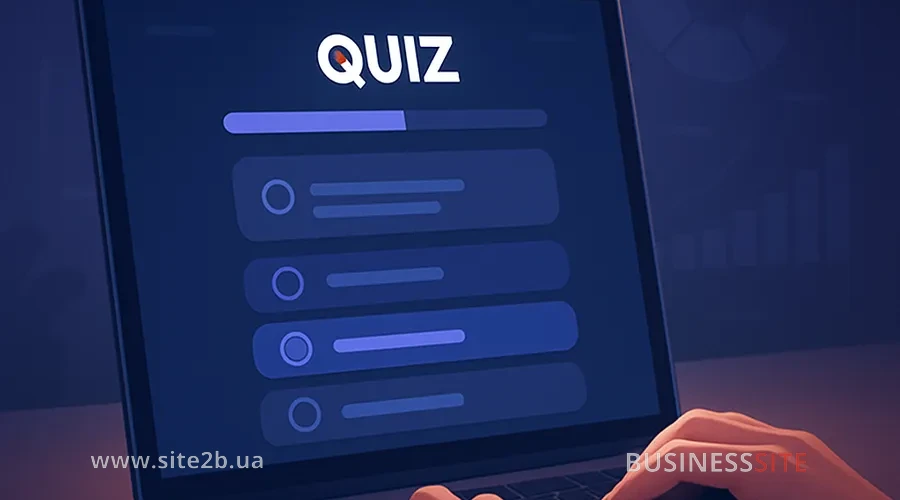
Website quizzes: a universal tool. I use four working formats: diagnostic (B2B and services), entertainment (engaging a broad audience), product selection (e‑commerce), lead magnet quiz (result in exchange for an email). The funnel often looks like this: quiz → gated results → collecting email addresses → segmented nurture sequence → personalized offer.
A content checklist helps avoid chaos.
- 5–8 questions, a comfortable length, with a progress bar.
- One question — one idea, with quick answer options.
- Logical branches at key decision points (for example, «who the purchase is for»).
- Progressive profiling: in the first touch — basic markers, in the second — clarifying ones.
- Dynamic prompts and micro-rewards for progress.
- Result page — clear, with value and an obvious CTA to subscribe.
Lead magnet quiz — how to collect emails
Strong offers:
- «individual set of medications and instructions» for the pharma category,
- «30-day renovation checklist» for the developer,
- «credit card selection with cashback calculation for PrivatBank/Monobank» for the fintech audience.
Success metrics are simple: the share of those who saw the result and left an email; CTR on the offer from the result; the open rate of the first emails and subsequent click-to-open. To optimize subscription conversion via the quiz, it’s worth testing the wording of the value proposition, the placement of the email request (before/after the result) and the visibility of the bonus.
Wheel of Fortune on the website: mechanics, prizes

The wheel of fortune on the site is a quick way to lift conversion of pop-up forms. The basic mechanics: display trigger (timeout, exit intent, scrolled to X%), email required to spin, prize awarded with a probability. In e‑commerce discounts, free delivery by Nova Poshta, promo codes for accessories, and a higher-value prize drawn once a week work well.
The prize structure sets the economics. I balance small guaranteed benefits (for example, −5% or free delivery) and rare big prizes (−20%, gift certificate). Probabilities and caps protect margins, while micro-rewards and variable rewards keep interest without the feeling of a “lottery about nothing.” BUSINESS SITE specialists recommend setting a cap on prizes and monitoring costs through a prize-logistics dashboard.
Giveaways: sweepstakes vs gambling
The line is defined by the presence of an entry fee and the dominance of chance. Sweepstakes — a promotion without an entry fee and with transparent odds; gambling: a game of chance. For promotions you should clearly state the rules for campaigns with game mechanics: dates, entry conditions, odds, list of prizes, winner selection procedure and organizer contact details.
Game widgets on the site: integration

There are three approaches: no‑code platforms, ready‑made widgets (plugins), custom development. No‑code is the fastest for hypotheses and A/B tests, especially if interactive quizzes for lead generation are needed “here and now”. Ready‑made widgets offer a compromise between speed and flexibility. We recommend custom development when complex branching, integration with a CDP, a proprietary design system, or high loads are important.
Technical requirements are clear: mobile‑first, a PWA approach for instant loading, Core Web Vitals (speed, responsiveness), as well as stable interactivity. Historically we tracked First Input Delay, now Google focuses the metric on INP, the target response time for interactions. Scaling implies rate‑limiting on APIs, queues for sending webhooks, retries on failures and a budgeting plan for cost scaling with traffic of 100k+ leads per month.
CRM and ESP integration
Server-side tracking and webhooks for leads
Server‑side tracking increases stability and GDPR compliance, and also helps bypass ad‑blockers within the rules. We often deploy a server‑side GTM container and send events to ga4/BigQuery with server‑side validation. Webhooks are used for instant transfer of leads to CRM/ESP with request signing and retries on failure.
Email lead validation happens immediately: syntax, MX records, disposable‑domain risk assessment. For manageability of metrics I collect a key metrics dashboard: impressions, clicks, quiz start, completion, email capture, prize issuance, cost per lead, fraud rate, email response rate. Such a dashboard with alerts allows responding within hours rather than weeks.
UX design for quizzes and the wheel of fortune
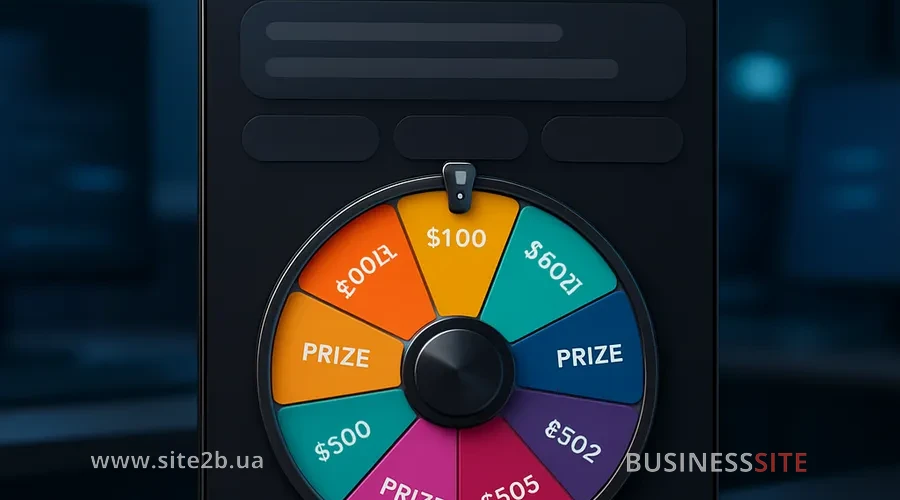
The architecture of questions affects speed and the sense of control. I prefer 1 screen – 1 question, a visible progress bar and logical branching only where an answer fundamentally changes subsequent steps. Hints next to fields and example answers reduce cognitive load and improve the UX design of quizzes to reduce drop-off.
Microinteractions and game loops sustain the rhythm: light animations on selection, micro-rewards (“+10 points for accuracy”), variable reward when revealing the result. Accessibility (a11y) is mandatory: sufficient contrast, keyboard focus, ARIA attributes, touch target size for a finger on mobile. Such an approach improves conversion and reduces the drop-off rate after the quiz.
Octalysis/Hook Model/choice architecture
Nudge techniques and behavioral economics boost CTR: time limits for the “best prize of the day”, a clear choice architecture (up to 4 options per screen), explicit highlighting of the recommended step. Specific triggers and CTAs work better when they state the benefit: “Get a personalized plan in 30 seconds”, “Spin the wheel, claim free shipping now”.
GDPR/ePrivacy Consent Collection

Privacy‑by‑design starts with data minimization and transparency. In a game widget it’s important to clearly state the purpose — growing the subscriber base and personalizing emails; show a link to the policy; explain how responses are used. Double opt‑in and user consent improve list quality and enhance deliverability.
Deliverability and retention after quizzes
The onboarding flow is built around value: a welcome series with the promised result/bonus, product tips and soft CTAs. Subject line tests and drip campaigns for new subscribers keep interest without overload. Post-campaign metrics: deliverability, open rate, click rate, unsubscribes, spam complaints and a reduction in the bounce rate after the quiz on the site (bounce rate as a web metric and soft/hard bounces in mailings).
A/B, MVT, and split tests of offers
I form hypotheses for A/B testing of quizzes around the offer, length, whether email is required, the position of the email request and the structure of prizes. In MVT you can test combinations of visuals, copy and reward formats. I calculate statistical significance in advance to plan traffic and test duration, and to account for seasonality.
Interpreting results requires a combination of metrics: uplift in subscription conversion, change in CPL, impact on CTR of interactive widgets, downstream effect on LTV. Split tests of offers and rewards in quizzes show how the value and rarity of prizes change behavior. At BUSINESS SITE we maintain a library of test templates and accumulated statistics by verticals.
Hypotheses for A/B tests
- Offer: discount vs personalized content. Hypothesis: content increases subscription conversion by 15–20% in B2B, discount by 10–15% in e‑commerce.
- Email requirement: request before the result vs after. Hypothesis: conversion is higher after the result, but CPL increases; evaluation across traffic sources.
- Widget visual: static wheel vs animated interaction. Hypothesis: animation raises CTR, with careful speed to avoid “visual noise”.
- Quiz length: 5 questions vs 8, all else equal. Hypothesis: 5 is faster, but 8 gives better segmentation and increases the effectiveness of nurture chains.
Measuring the ROI of gamification
For accurate accounting I set up Google Analytics 4 for quizzes and the prize wheel, GTM for events and parameters, as well as UTM tags and campaign tracking across all sources: Meta, Google Ads, TikTok, email. Multi‑touch attribution records the quiz’s contribution as touchpoints; cohort analysis of retention after the quiz shows how the audience from the interactive element is retained and makes purchases.
The key metrics dashboard includes: impressions, clicks, starts/completions, subscription conversion, CPL, CTR, prize distribution, fraud rate, open/click, revenue and LTV.
Setting up GA4 and GTM for quiz campaigns
Event list: quiz_view, quiz_start, quiz_step, quiz_complete, email_capture, prize_spin, prize_win, prize_redeem, out_of_stock_prize, consent_granted. Custom parameters: quiz_id, variant, step, result_category, prize_type, prize_probability, utm_source/medium/campaign, device_type.
Fraud and lead quality
Fraud detection and bot filtering are mandatory elements. I use rate-limiting for prize wheels, behavioral signals (click speed, recurring patterns), device fingerprinting within privacy constraints, and reCAPTCHA/Turnstile at higher-risk stages. For prizes, limits on address/device/time.
Lead quality assessment: via email validation, enrichment APIs (domain, company, role checks), and manual spot verification. In cases of confirmed fraud, promo rules provide for prize revocation or replacement with a nominal equivalent. The practice of BUSINESS SITE shows that clear terms and technical barriers keep the fraud rate at <1%.
Tools for quizzes and spin-the-wheel
Checklist of technical requirements for the platform
- Integrations: webhooks, REST API, native connectors to CRM/ESP/CDP.
- A/B testing of quizzes, split by offer/visual, variant statistics.
- Mobile‑first, PWA, minimal loading latency, Core Web Vitals optimization.
- Flexible configuration of prizes and probabilities, anti‑fraud and rate‑limiting.
- Localization, Cyrillic support, GDPR/ePrivacy compliance, consent storage.
- SLA for uptime, event logging, export to BI.
Gamification cases in e-commerce and B2B
Case 1, pharma e‑commerce. Before: the subscription form converted at 1.9%. After implementing a lead magnet quiz “package selection” and a welcome series: conversion to subscription 5.6%, CPL – ↓ by 42%, open rate of the first series: 58%, repeat purchases growth after 60 days: +17% (LTV effect). Lesson: a personalized result + quick issuance of a promo code for “Nova Poshta” increase motivation.
Case 2, laboratory services B2B. A diagnostic quiz with a gated result “laboratory maturity assessment” and booking for a consultation. MQL increased by 31%, lead scoring allowed increasing lead processing speed, the channel’s payback period shortened by 22%. Legal issues were resolved through clear rules and double opt-in.
Case 3, online electronics store. Wheel of Fortune + promotion “free delivery from 1500 UAH” via “Nova Poshta”. Widget conversion 11.8%, subscriber base growth 2.3× in 30 days, coupon CTR: 28%, total revenue from the email channel +24% for the quarter. Lesson: a balance of prizes and time limits increases coupon use.
Case 4, financial services. Quiz “card selection with cashback PrivatBank/Monobank”, then personalized email scenarios. Conversion to subscription 8.4%, CPL 37% below the benchmark, cohort analysis of retention after the quiz showed higher open rates and conversion to application. Lesson: simple questions + a clear result build trust in the brand.
Launching a quiz/spin-the-wheel on the landing page
Preparation:
- Goals and KPIs: CPL, conversion to subscription, CTR, target payback.
- Format selection: quiz marketing or spin-the-wheel, lead generation, offer, prize math.
- Jurisdiction and participation terms: rules, odds, consent logging, fulfillment.
Technical implementation:
- Platform or custom, integration of quizzes with CRM and ESP, data mappings.
- Setting up webhooks for sending leads to the CRM, tagging and event tracking via GTM.
- Server-side tracking, Consent Mode, baseline Core Web Vitals.
Testing and pre-launch:
- QA of scenarios, prize run-throughs, fault tolerance.
- A/B testing of quizzes on offer/email placement, load tests.
- Anti-fraud: rate limits, CAPTCHA, email validation.
Launch and first 30/90 days:
- Dashboard monitoring, rapid split-tests of offers.
- Optimization of nurture sequences, adjustment of prize probabilities.
- Scaling for high load and assessment of cost scaling.
Which metrics to track after launch
Key metrics: CPL (cost per lead) for quiz, conversion to subscription, CTR of interactive widgets, open/click, deliverability, unsubscribes/complaints, cohort‑retention and LTV. For e‑commerce: add‑to‑cart and purchases from segments; for B2B, MQL processing speed and conversion to SQL.
Frequently asked questions from practitioners
Answer: Included in the calculation: additional margin from orders by subscribers acquired through the wheel; cost of traffic; licenses/development; prize pool and logistics; operational expenses. ROI = (Margin − Costs) / Costs. It’s useful to calculate the payback period and the sensitivity to changes in prize probabilities.
Answer: Subscription conversion, CPL, widget CTR, deliverability of the first emails, open rate of the welcome series, fraud rate, webhook/ESP response time. Alert thresholds: conversion drop >20%, deliverability <95%, spam complaints >0.2%.
Answer: Map the data, send email, answers, UTM, source via webhooks. Set up events and tags, start welcome and nurture sequences by segments, implement lead scoring based on answers, link lead statuses to sales tasks.
Answer: It’s important to distinguish sweepstakes and gambling mechanics; publish rules with odds and deadlines; ensure the right to participate without purchase; comply with GDPR/ePrivacy, UK GDPR, CAN-SPAM/CASL and local requirements. Documentation and consent logging are mandatory.
Answer: Perform email validation, implement double opt-in, warm up the domain, start sending to the most active segments, monitor sending frequency, test subject lines, maintain database hygiene and remove inactive users through re-engagement.
Conclusion and call to action
I believe gamification is a precise tool for growing the subscriber base, lowering CPL and boosting LTV. Quizzes and the wheel of fortune on a website are not about “fun for fun’s sake”, but about a managed economy: clear KPIs, a transparent legal framework and technological discipline. BUSINESS SITE’s experience confirms: when the offer is honest, the UX is simple, and analytics are rigorous, the channel delivers predictable revenue and becomes a pillar in the marketing funnel.
Rate the article:





