
I have encountered this dozens of times: executives invest in advertising, launch new landing pages, but do not get clear answers about what actually works and what simply “eats” the budget. At BUSINESS SITE we see that even experienced marketers and product teams often get lost in the variety of A/B testing platforms: VWO, Optimizely, AB Tasty, Adobe Target, Convert — each tool promises the maximum, but in practice the differences are critical for effectiveness and ROI.
Today the requirements for A/B testing platforms have grown: businesses need no-code solutions for quick launches, server-side A/B testing with feature flags for complex digital products, deep integrations with Google Analytics 4, Amplitude, CRM and CDP, as well as support for multichannel campaigns and OTT platforms. Added to this are the 2025 trends: AI segmentation, multivariate experiments, personalization, and automation of analysis and reporting.
In this article I will break down the strengths and weaknesses of the key platforms, show how to choose a tool for your company’s needs – from small business to enterprise, taking into account Ukrainian realities, and share practical conclusions based on BUSINESS SITE’s experience. If you want to stop guessing and start managing results: I recommend reading to the end.
A/B testing
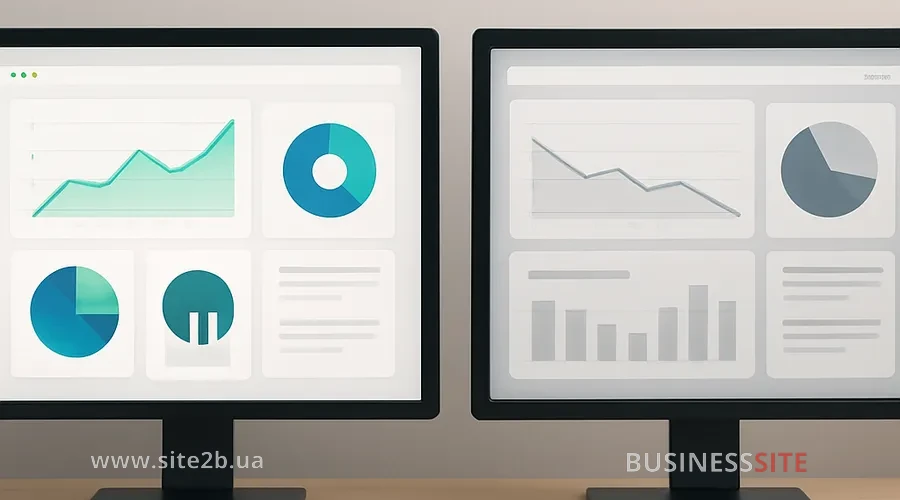
In my experience, this approach allows you to abandon guesses and make decisions based on data: this is the essence of data-driven marketing.
Modern A/B testing platforms have long since moved beyond simple split tests. In the arsenal are no-code editors, multivariate testing, server-side experiments, feature flags for quick feature control, as well as AI segmentation, which opens new horizons for personalization. At BUSINESS SITE we see that proper implementation of these tools not only increases conversion but also builds a culture of product and UX experiments where hypotheses are tested quickly and transparently.
A/B testing and statistics
Any experiment starts with a hypothesis and a clear success metric. Traffic is split into control and test groups, after which user behavior is analyzed. The key point is statistical significance: you cannot rely on “feelings”; it is important to ensure that the difference between variants is not random.
In 2025 most platforms use two approaches to analysis: frequentist statistics (classic statistics) and Bayesian statistics (Bayesian stats). The Bayesian approach, used by, for example, VWO (SmartStats), allows faster decision-making and automatically determines the winner, which is critical for saving time and controlling experiment quality. In a case for a pharmaceutical company we encountered that classic statistics delayed the decision-making process, and switching to Bayesian analysis sped up the experiment cycle twofold.
Impact of A/B testing on ROI and business
Regular A/B testing is not only an increase in conversion but also a reduction in customer acquisition cost (CAC), increase in LTV, and improved retention. In our observations, even simple UX experiments with an order form or a “Buy” button can yield a conversion uplift of 10–25%, and automating analysis and implementing AI segmentation allows quickly identifying new growth points.
In one project for an online store we implemented automatic winner detection in A/B tests, which made it possible to save up to 40 hours of marketers’ work per month. The long-term effect of regular tests: it is not only revenue growth but also the formation of a culture of continuous improvement where decisions are made based on data rather than intuition.
Criteria for choosing an A/B testing platform in 2025
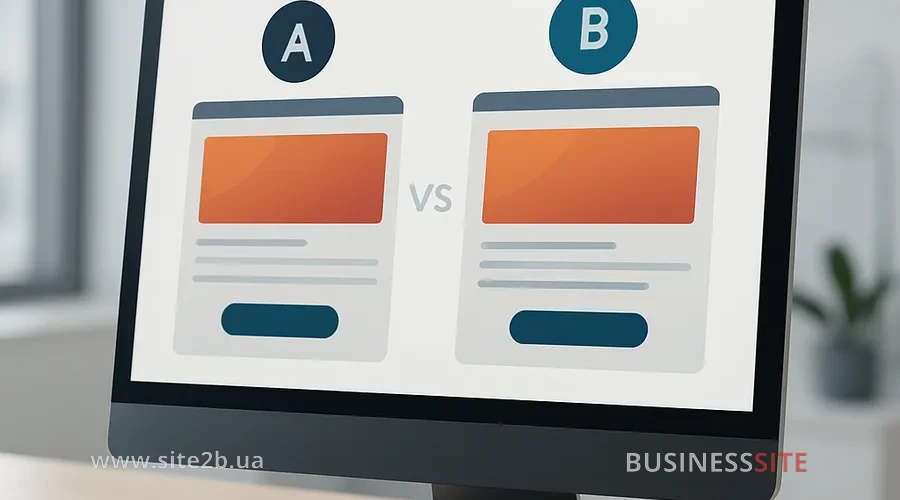
The choice of platform depends on tasks, team size, technical resources and testing goals. At BUSINESS SITE we always start with a needs analysis: who will work with the platform – marketers, product managers, UX designers or developers? Do you need to run tests without code, or is support for server-side and feature flags critical? Is integration with analytics, CRM, CDP important?
In 2025 the following criteria come to the forefront:
- No-code A/B testing for quick hypothesis launches without involving developers.
- Server-side testing and feature flags for complex digital products and mobile apps.
- Deep integrations with Google Analytics 4, Amplitude, HubSpot, Salesforce, CDP.
- AI segmentation and experiment automation for personalization and accelerated analysis.
- Scalability and support for multichannel campaigns, including OTT and Android TV.
- Pricing transparency and flexible pricing plans.
- Quality technical support and availability of free/demo versions for a quick start.
No-code A/B testing
No-code solutions are the key to speed. Drag-and-drop and WYSIWYG editors allow launching experiresults in hours, not weeks. In a case study for a travel agency we implemented a platform with a multi-test builder, which allowed marketers to independently test hypotheses without involving the dev team and save up to 30% of the budget on external contractors.
Server-side A/B testing and feature flags
Server-side testing and feature flags: a must-have for complex digital products, mobile applications and high-load services. This approach allows managing functionality “on the fly”, quickly rolling back changes and minimizing risks. In a project for a bank we implemented server-side experiments via an SDK, which ensured stability and security when testing new features.
Integrations and analytics
Integration with Google Analytics 4, Amplitude, BigQuery, HubSpot, Salesforce and CDP is not just a convenience, but the foundation for end-to-end analytics and data-driven decisions. Using heatmaps, session recordings and funnel analytics allows a deeper understanding of user behavior and finding growth points. In BUSINESS SITE practice, integration with Amplitude and GA4 allowed one laboratory to optimize the user journey and increase conversion by 17%.
Customer support and pricing
Transparent pricing, availability of free and demo versions, SLAs and support plans are important criteria for Ukrainian businesses, where every investment must be justified. We recommend choosing platforms with clear pricing policies and fast support to avoid unexpected expenses and downtime.
Comparison of A/B testing platforms: VWO, Optimizely and others
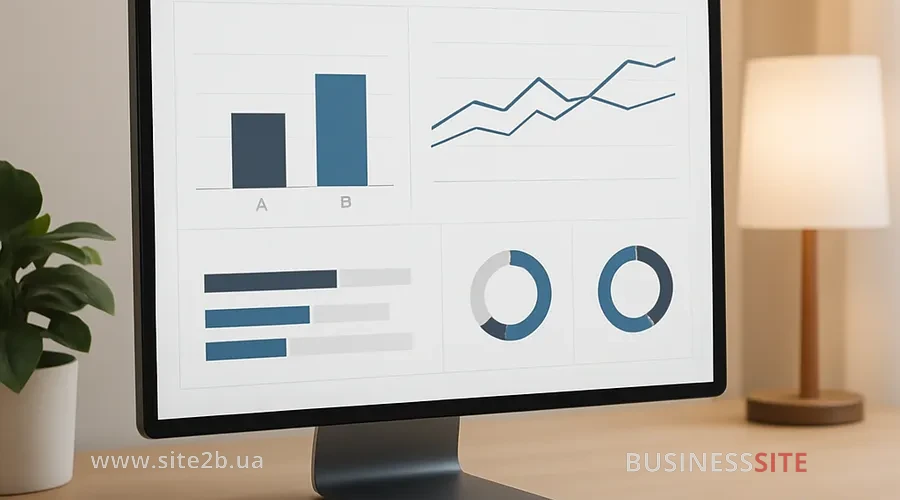
In recent years the BUSINESS SITE team has analyzed and implemented various platforms for clients from e-commerce, pharmaceuticals, banking and construction sectors. Each tool has its strengths and limitations, and it’s important to choose a solution for specific tasks.
VWO review: no-code A/B testing for SMB
VWO: the optimal choice for small and medium businesses, as well as product and UX teams that value speed of launch and interface simplicity. Drag-and-drop editor, SmartStats (Bayesian statistics), SmartCode, Android TV/OTT support, integrations with GA4, Amplitude, HubSpot, Salesforce make the platform universal for most tasks. In a case for an online store we implemented multivariate testing with automatic winner selection, which helped speed up the time-to-market of new features.
Limitations: no feature flags, AI segmentation and AI text generation. For complex server-side scenarios and personalization, alternatives should be considered.
Optimizely: comparison of server-side A/B testing and feature flags
Optimizely is the flagship among enterprise solutions, aimed at companies with strong technical teams. Support for server-side A/B testing, feature flags, multivariate testing, deep analytics, integrations with BigQuery, Segment, CDP, Slack: all of this makes the platform indispensable for large-scale digital products. In one of the projects for a construction company we used Optimizely to manage rollout strategies without the need to release new code.
Limitations: high cost, weak no-code support, lack of AI segmentation. For SMBs and marketing teams without dev resources, the platform may be excessive.
AB Tasty: AI segmentation and marketing
AB Tasty is the choice for marketers and UX designers who value visual editors, AI segmentation, UX widgets, integrations with GA4, Mixpanel, Hotjar. ROI dashboards and heatmaps are available in Pro/Enterprise plans. For a laboratory in the pharmaceutical sector we used AI segmentation to personalize offers, which resulted in a 21% increase in conversion.
Limitations: advanced analytics and automation are available only on higher plans.
Adobe Target integrations for multichannel campaigns
Adobe Target: a platform for large corporations already using Adobe Experience Cloud. Deep integration, multichannel campaigns, feature flags, WYSIWYG editor, support for OTT and mobile platforms. In a case for a large e-commerce we implemented multichannel campaigns with personalization at all stages of the funnel.
Limitations: high entry barrier, implementation complexity, lack of AI segmentation.
Convert for SMB – pricing and no-code A/B testing functionality
Convert, the optimal solution for small and medium businesses where transparent pricing, AI segmentation, multivariate testing, integrations with Shopify, WordPress, HubSpot, and a 14-day demo are important. In a case for e-commerce we implemented experiment automation without developer involvement, which allowed rapid hypothesis testing and saved resources.
Limitations: no feature flags, SmartCode, AI text generation.
Comparison table of platforms
| Platform | Strengths | target audience | Limitations |
|---|---|---|---|
| VWO | No-code editor, SmartStats, SmartCode, Android TV, GA4 integration | SMB, mid-sized businesses, non-technical teams | No feature flags, no AI segmentation |
| Optimizely | Server-side tests, feature flags, multivariate testing, BigQuery, CDP | Enterprises with technical resources | Weak no-code support, high price, no AI segmentation |
| AB Tasty | AI segmentation, UX widgets, visual editor | Marketing, UX, mid-sized businesses | ROI dashboards, heatmaps – Pro/Enterprise |
| Adobe Target | Deep Adobe Cloud integration, multichannel campaigns | Large corporations, Adobe Experience Cloud | High entry barrier, no AI segmentation |
| Convert | Transparent pricing, AI segmentation, no-code | SMB, marketing and product teams | No feature flags, SmartCode |
How to choose an A/B testing platform for your business

I always recommend starting with an analysis: who will run the tests, what tasks the team faces,
how important is launch speed, whether server-side experiments are needed, how critical integration with analytics and CRM is, and whether there is a need for AI segmentation and scaling to OTT platforms.
- Quick launch without developers: VWO, AB Tasty, Convert – optimal for marketers and product teams, allow launching tests using drag-and-drop editors.
- Server-side tests and scalability: Optimizely, Adobe Target – a choice for enterprises where feature flags, deep analytics, and support for BigQuery and CDP are important.
- Visual UX testing and personalization: VWO, AB Tasty, Convert – strong in no-code, AI segmentation, and UX widgets.
- Transparent pricing: Convert: clear plans, no hidden fees, free demo.
- Deep integration with analytics and CRM: Optimizely, VWO, AB Tasty, support integrations with GA4, Amplitude, HubSpot, Salesforce.
- Adobe Experience Cloud: Adobe Target: for companies already using the Adobe ecosystem.
- AI segmentation: AB Tasty, Convert – automation of personalization and accelerated analysis.
- Multichannel campaigns and OTT: Adobe Target, VWO, Optimizely, AB Tasty – support for Android TV and OTT platforms.
Recommendations for small and medium-sized businesses
If transparent pricing is critical, and no-code functionality and AI segmentation are needed – Convert and VWO will provide the maximum capabilities without extra costs and implementation complexity.
Enterprise sales
For server-side tests, feature flags, BigQuery and multichannel campaigns, Optimizely and Adobe Target provide scalability and flexibility but require technical resources and budget.
Tips for marketers and UX designers
Visual editors, AI segmentation, UX widgets are strengths of AB Tasty and VWO. This allows quickly testing hypotheses without distracting the dev team.
Important considerations when choosing and implementing an A/B testing platform

- Which platform provides maximum flexibility and ease for non-technical users?
VWO, AB Tasty, Convert – leaders among no-code solutions. - How to integrate A/B testing with Google Analytics 4, Amplitude and CRM?
All the platforms reviewed support integrations with GA4, Amplitude, HubSpot, Salesforce, but the depth of integration varies. - Which platforms support server-side testing and feature flags?
Optimizely, Adobe Target, optimal for complex digital products. - How important is AI segmentation for increasing conversion?
In BUSINESS SITE’s experience, AI segmentation enables personalization of offers and accelerates conversion growth, especially in e-commerce and pharma. - How to scale A/B testing at the enterprise level?
Optimizely, Adobe Target, VWO: support scaling, traffic management, and experiment automation. - How to assess ROI from implementing a paid platform?
Compare conversion uplift, time savings, reduced CAC and increased LTV – these metrics are available in ROI dashboards of most platforms. - What are the limitations in integrations and customization of the platforms?
Clarify the list of integrations and the possibility of custom development at the selection stage, Convert and AB Tasty offer higher flexibility, while Adobe Target and Optimizely provide maximum depth but have a higher entry barrier. - How to choose a platform without strong dev support?
No-code solutions (VWO, AB Tasty, Convert), the best choice for marketing and product teams. - Which platforms offer transparent pricing and no hidden fees?
Convert, a benchmark of transparency, VWO and AB Tasty are also clear for SMBs. - How to ensure data security and privacy?
All platforms comply with international security standards, support GDPR, and advanced privacy settings are available for enterprises. - Which platforms are suitable for multichannel campaigns and cross-device testing?
Adobe Target, VWO, Optimizely, AB Tasty – support for OTT, mobile, and web platforms. - How to automate winner determination in A/B tests?
VWO (SmartStats), AB Tasty, Convert: automation of analysis and winner notifications. - Which platforms support testing on Android TV and OTT?
VWO, Optimizely, AB Tasty: support SDKs for iOS/Android and OTT. - How to reduce risks when scaling experiments?
Use feature flags, server-side tests, control groups, and automatic winner determination. - What long-term effects does regular A/B testing produce?
Increased conversion, reduced CAC, higher LTV, and the formation of a data-driven culture. - How to evaluate the statistical significance of results?
All platforms provide built-in tools for statistical calculation, VWO and AB Tasty use a Bayesian approach to speed up analysis. - Which platforms enable UX experiments?
VWO, AB Tasty, Convert, strong in visual tests, heatmaps, and session recordings. - How to choose a platform if using the Adobe or Google ecosystem?
Adobe Target: for Adobe Experience Cloud, VWO and AB Tasty: for Google-oriented companies. - How to ensure customer support and quick resolution of technical issues?
Evaluate SLAs, availability of local support, and response speed: in BUSINESS SITE’s experience, Convert and VWO stand out for customer focus.
A/B testing: choosing a platform in 2025
A/B testing is the foundation of conversion optimization and business growth, and the right platform choice determines the speed, transparency, and ROI of experiments. The decision depends on objectives, technical resources, and budget: for SMBs and marketing teams, Convert, VWO, AB Tasty; for enterprises and complex digital products: Optimizely, Adobe Target.
BUSINESS SITE’s practice confirms: regular experiments, analysis automation, AI segmentation, and integration with analytics provide steady growth and resource savings. I recommend starting with free or demo versions to assess usability and functionality, and also to pay attention to pricing transparency and support quality.
Rate the article:





