
Web analysts play a key role in business development by analyzing user behavior on the site and helping the company make informed, data-driven decisions.
A web analyst can, for example, identify that at a certain stage of the sales funnel, the company is losing 40% of potential clients. Or they may analyze which advertising channels bring the highest returns, reducing ad costs by 20%. All of this is not abstract numbers but real business benefits.
One of the key features of this profession is that you can learn it at any age. To start working as a web analyst, you don’t need programming skills, although technical knowledge can be useful. What is more important is to have an analytical mindset, be able to work with data, and be ready for continuous learning.
This article will help you understand where to start, which skills are essential for a web analyst, and how to build a career in this exciting and promising profession.
Main tasks and responsibilities of a web analyst
A web analyst is a specialist who collects, analyzes, and interprets data about user behavior on the site. The main goal of a web analyst is to help businesses understand how people interact with their web resources and offer solutions to improve site performance, whether it’s increasing conversion rates, enhancing user experience (UX), or optimizing advertising expenses.
Main tasks of a web analyst include:
- Data collection and analysis of user behavior on the site. A web analyst uses tools such as Google Analytics, Adobe Analytics, and other platforms to track visitor actions on the site. These could be data on which pages users view, how long they stay on the site, where they most often “drop off” (leave the site), or which traffic sources bring in the most customers. The key task is to interpret this data and determine which pages are effective and which need optimization.

 Example from our experience: One of our clients, a large logistics company, faced the problem of low conversion on a form submission page. After analyzing the data, we discovered that 70% of users did not complete the form because the process was too lengthy. We proposed reducing the number of fields in the form, which led to a 25% increase in conversions.
 - Optimization of user experience (UX). Analysts closely study how users interact with the site, identify problem areas, and suggest improvements. A web analyst may notice that users spend a lot of time on a particular page but do not take the desired action (such as making a purchase). The reason might be complicated navigation, an inconvenient interface, or insufficient information.
Example from BUSINESS SITE practice: We worked with a pharmaceutical company that was launching a new online store. The analysis showed that customers were confused at the product selection stage due to a complicated interface. After implementing improvements in the catalog structure and simplifying the selection process, sales increased by 18%.
- A/B testing. One of the most important tools for a web analyst is A/B testing. This method involves creating two versions of a page (or an element on a page) and testing which one performs better. The web analyst is responsible for setting up such tests, running them, and analyzing the results.
Example: As part of one of our projects with an e-commerce company, we conducted A/B testing of a landing page. The first version of the page had a long text with a detailed product description, while the second focused on visuals and short benefits. The results showed that the second version boosted conversions by 12%.
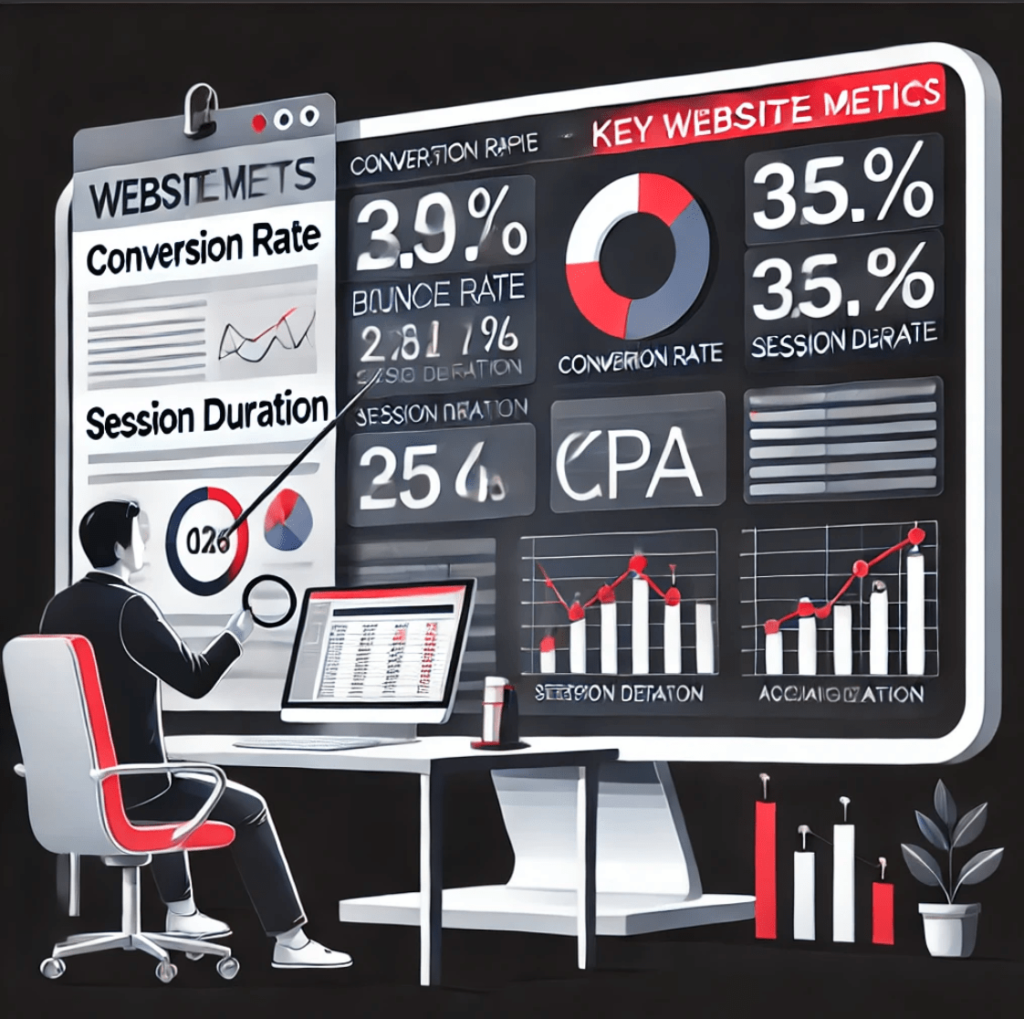
- Monitoring and reporting on key metrics. A web analyst must constantly track the key performance indicators (KPIs) of the site: conversion rate, average session duration, bounce rate, customer acquisition cost (CPA), and others. Based on this data, the analyst develops recommendations for improving the site and provides reports to management and marketing teams.
Example from BUSINESS SITE: We developed a regular reporting system for one of our clients, a leading law firm. It allowed the marketing department to quickly track the results of advertising campaigns and adjust strategies to increase traffic. This led to a 15% reduction in customer acquisition costs.
- Analysis of the effectiveness of advertising campaigns. Web analysts also evaluate the effectiveness of various marketing channels, such as PPC (pay-per-click) advertising, SEO promotion, and targeted advertising. Based on data analysis, marketing budgets can be optimized by reallocating them to more effective channels.
 Example: For one of the construction companies, we analyzed the effectiveness of advertising channels and found that Google Ads generated more leads than Facebook targeting, and at a 20% lower cost. This allowed the client to reallocate the budget and increase inquiries by 30%.



Education and courses for web analysts
The foundation for skill development is provided by various courses and programs, including free options offered by major companies like Google.
Free analytics courses from Google
- Google Analytics for Beginners — a course for beginners where you’ll learn the basics of setting up and working with Google Analytics.
- Advanced Google Analytics — a more advanced course that covers the use of more complex functions for data analysis and report building.
- Google Tag Manager Fundamentals — a course that teaches working with tags and setting up tracking on the site.
Free web analytics courses from other major companies
- Facebook Blueprint. Facebook also offers free web analytics and digital marketing courses through its Facebook Blueprint platform. These courses cover various aspects of data analysis and social media promotion, which can be useful for web analysts working with advertising campaigns on Facebook and Instagram.
- HubSpot Academy offers free courses on analytics, marketing, and CRM systems. Especially useful is the course on Marketing Analytics, which covers key aspects of data analysis to improve marketing strategies.
- Microsoft Learn If you’re interested in data analytics and visualization using Microsoft tools, Microsoft Learn offers free Power BI courses that are useful for creating interactive dashboards and data-based reports.

Other educational platforms for web analysts
- Coursera and Udemy offer both paid and free courses on web analytics. For example, on Coursera, you can take the “Foundations of Data Science” course from universities, which provides a foundation for a deeper understanding of data analytics and web analytics in particular.
- LinkedIn Learning offers accessible programs for learning web analytics and working with Google Analytics, as well as courses on Python and SQL for handling large datasets.
Courses in statistics and data visualization

- Courses on statistics from Khan Academy are an excellent option for gaining basic knowledge in statistics and its application in web analytics.
- Tableau courses — on Tableau Public, you can find free resources for learning how to work with this visualization tool.
How to gain experience and create a web analyst portfolio
Therefore, creating a portfolio as a web analyst is an important step in starting your career. It might seem challenging, especially if you don’t have real projects, but there are several simple and specific steps you can take to start gaining experience and creating case studies. Here’s how you can do it:
- Offer your services for free or for a symbolic fee
At the initial stage, many web analysts offer their services to small businesses or non-profit organizations for free or for a small fee. This is a great way to get real projects and add them to your portfolio. You can offer a site analysis, create reports, and provide optimization recommendations in exchange for feedback and references.
Example: you could approach a local coffee shop or a small online store with an offer to audit their site and advertising campaigns. Even if it’s a small project, its results can be included in your portfolio. - Freelance platforms
Registering on freelance platforms like Upwork, Freelancehunt, or Kwork is an excellent way to find projects. On these platforms, small and medium businesses post requests for site analysis, advertising campaign analysis, or improving user experience. By starting with smaller projects, you can gradually build up experience and add real case studies with results to your portfolio.In our blog, we have a detailed article on how to successfully work as a freelancer in 2024! - Training projects and simulations
Many courses and educational programs offer assignments that closely resemble real-world practice. This is a great opportunity to practice on simulated data and include such projects in your portfolio. For example, you can participate in web analytics competitions or practice with open datasets.Many courses on Coursera or Udemy offer practical tasks that you can later use as case studies. Analyzing mock data with concrete results also demonstrates your skills. - Internships and volunteering
Many companies are looking for interns or volunteers who can help with analytics. Even if this is not a paid position, an internship gives you access to real data, and you can work with real business challenges.For example, if you’re interning at a company that operates in e-commerce, you could analyze their sales funnel, identify problems at the checkout stage, and suggest solutions. - Working on cases with hypothetical data
Another option is to create case studies based on hypothetical data. You can imagine a situation where you have specific data on traffic and user behavior, and based on this data, propose a strategy to improve performance. Such cases can also showcase your skills and analytical approach.
You can use Chat GPT — it can significantly simplify the task.



Creating a web analyst portfolio
To create a high-quality portfolio, it’s important not only to gather projects but also to present them correctly. Include in each case: project goals, tools used, results, your conclusions, and recommendations.

Example of a well-formatted case in a web analyst portfolio:
- Project goal:
Analyze an online store’s website to identify reasons for a high bounce rate and suggest solutions to reduce it and increase conversion rates. - Tools used:
Google Analytics to analyze user behavior and key metrics, A/B testing to verify changes on the page, and Google PageSpeed Insights to analyze load speed. - Results:
After implementing the recommendations, the bounce rate decreased by 15%, and conversion rates increased by 10%. Page load time was reduced by 30%, which positively affected user behavior. - Conclusions and recommendations:
The analysis showed that long page load times led to traffic losses and high bounce rates. We proposed optimizing images, reducing the number of external scripts, and implementing caching. It is recommended to continue monitoring metrics through Google Analytics and conduct additional tests for further optimization of high-traffic pages.
Conclusions and recommendations
Conclusions:
- Web analytics is a key profession in digital marketing that helps businesses optimize web resources, increase conversions, and improve user experience.
- Data analysis is the foundation of decision-making. Without proper analysis, businesses miss important opportunities to increase sales and optimize costs.
- The profession can be mastered at any age, without requiring deep technical knowledge. The main requirements are an analytical mindset and a willingness to continuously learn.
- Modern AI and neural network tools enable web analysts to work faster and more accurately, making predictions and optimizing processes.
- Web analytics offers flexibility in choosing a work format, whether it’s office work or freelancing.

Recommendations:
- Start with free courses like Google Analytics Academy and Facebook Blueprint to gain basic knowledge and certification, which will increase your value in the job market.
- Practice on real or training projects, including your own websites or small businesses, to create a portfolio with real case studies and results.
- Develop technical skills — learn SQL and Python, study data visualization tools such as Tableau and Google Data Studio to expand your analytics capabilities.
- Look for internships or freelance projects on platforms like Upwork and Kwork to gain experience and build case studies for your portfolio.
- Stay updated with new trends and technologies in web analytics, such as the use of AI and neural networks, to remain a sought-after specialist.
Rate the article:





