According to various e-commerce studies, up to 70–80% of the organic revenue of online stores and services is generated by only 10–20% of pages, mainly transactional categories, subcategories and key landing page with commercial queries. Meanwhile, owners spend budget on developing and SEO-optimizing hundreds or thousands of URLs that don’t bring money and “dilute” the weight of the truly important pages.
I see this in almost every second project that comes to us at BUSINESS SITE: a complex, bloated SEO site structure, dozens of almost identical landing pages with similar intent, duplicate content, canonical URLs set up only partially, loading speed suffers, and then the surprise why the site’s SEO promotion doesn’t deliver the expected ROI.
The key question I regularly ask owners and marketers: are you willing to keep paying for extra pages that eat your budget and rankings, instead of strengthening 20–30 commercially critical URLs?
I am convinced: for most Ukrainian businesses — from online stores to banking and construction services: SEO site structure for transactional queries without extra pages provides the best balance between traffic, conversion and manageable SEO risks. This article is my step-by-step how-to: how to design such a structure, how to optimize it for user intent and how to manage scaling without chaos in indexing.
If you’re responsible for marketing or sales and want SEO to work as a predictable channel with a clear ROI, I recommend reading the material to the end: you’ll get an action framework that you can apply to your site or give to a contractor as a specific task, not “do SEO for us”.
Site structure for transactional queries without unnecessary pages
By the SEO structure of a site I mean a logical hierarchy of sections, categories, subcategories and landing pages that:
- reflects the real user path (Customer Journey);
- fulfills user intent for key commercial queries;
- remains clear to search engine algorithms and provides stable page indexing.
Transactional queries: these are queries with the intent to perform an action involving money or a specific service: «buy an air conditioner Kyiv», «book a tour to Egypt», «cash loan online», «blood test price», «turnkey house construction». This is not informational interest, but «I’m ready to buy / apply / sign up».
Why unnecessary pages harm results
When I conduct a SEO audit, I most often see three common problems:
Duplicate content and «thin» pages
- hundreds of filtered URLs without a well-thought indexing strategy;
- dozens of similar landing pages for almost identical commercial queries;
- regional or template duplicates of categories without a unique USP and content.
Search engine algorithms learn to understand intent and «merge» such pages into one group. As a result:
- rankings get diluted;
- page indexing deteriorates;
- the crawl budget is wasted, especially for large stores.
Worsening UX for transactional pages
The user lands on a URL where:
- the navigation structure is confusing;
- the path from entry to submitting an order or purchase takes 5–6 steps;
- filters, sorting and CTAs are not obvious.
In BUSINESS SITE projects we regularly see a direct correlation: the deeper the page in the structure and the more complicated the path, the lower the conversion and CTR from search results.
Drop in loading speed and technical metrics
Excess pages most often mean:
- extra scripts and templates;
- complicated filter logic and content generation;
- mobile optimization issues.
For transactional queries this is critical: every extra second of loading can eat into a double-digit percentage of leads.
Optimization without unnecessary pages and the role of intent
I believe that an SEO structure without unnecessary pages is not «minimum for the sake of minimum», but an exact hit on user intent:
- where one category is enough for a broad commercial query;
- where a separate subcategory is actually needed;
- where it’s better to use a filter + proper indexing than to clone pages.
In BUSINESS SITE projects we start planning the structure by analyzing intent:
- «buy / price / order» → clear transactional intent;
- «reviews / comparison / catalog» → commercial, but not yet ready to pay;
- «how to choose / instruction / what’s better» → informational, supportive.
Then I make architectural decisions: which URLs to make transactional, which to leave as informational support, and which to remove from the index or merge altogether.
Building a site structure for transactional queries without unnecessary pages
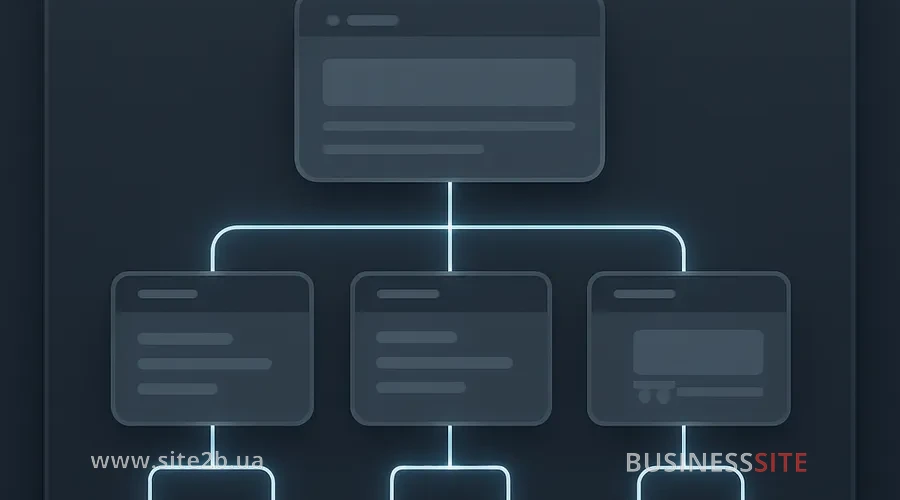
To minimize unnecessary pages and increase conversion, it’s important to properly compile and cluster the semantic core, arranging the structure to match visitors’ intent as closely as possible.
Collection and clustering of the semantic core
Any strategy starts with the semantic core. For the transactional part I always distinguish 3 levels:
- high-frequency commercial queries («оконные конструкции Киев»);
- mid-frequency specific queries («пластиковые окна цена», «окна Rehau купить»);
- long-tail queries («купить пластиковые окна с установкой в рассрочку»).
Approach to collecting and selecting keywords
I use a combination of tools and sources:
- system export from Google Search Console and Google Ads;
- analysis of marketplaces and niche leaders (for example, «Rozetka», Prom.ua) to understand users’ real terminology;
- specialized SEO tools such as SeRanking, Ahrefs, Semrush.
The principle is simple: each keyword must correspond to a clear intent and a potential landing page. If a keyword cannot be logically tied to a product, service, or commercial scenario: it is not included in the transactional core.
Clustering the semantic core without redundant clusters
Next begins the key stage: clustering the semantic core. I group queries:
- by product/service type;
- by type of action (buy, order, apply online, call out);
- by important modifiers (city, urgency, format, segment B2B/B2C).
The practice at BUSINESS SITE has shown: if clustering is built around a clear user intent, the number of required landing pages decreases by 20–40% compared to «searching for keywords for every little thing».
To maintain manageability:
- I use mind maps (Xmind Zen or similar) for visualization;
- for large projects I create a register: «cluster → page type → indexing status → traffic and conversion goal».
Important: keyword clustering should not automatically create new URLs. A landing page is created only if:
- there is a separate product/service with a distinct USP;
- there is a significant search volume;
- the page can be organically integrated into the structure and internal linking.
In all other cases, transactional queries are grouped into existing categories or landing pages, and duplicate content is resolved through rewriting, canonical URLs or 301 redirects.
Designing a site structure hierarchy to reach the goal in three clicks
Once clusters are defined, I design the hierarchical SEO structure. Basic logic for most commercial projects:
- Home
- Categories
- Subcategories
- Product card or landing page (landing page of the service)
The goal, an SEO structure with 3 clicks to the target page: it’s the optimal compromise between depth, manageability and UX.
Minimizing depth and navigation convenience
So that users and search bots can quickly reach transactional pages:
- I limit the number of nesting levels to 3–4;
- I duplicate access to revenue-generating categories via the menu, “popular services/products” blocks, banners;
- I avoid situations where an important category is at the 5th–6th level of nesting.
In one of BUSINESS SITE’s e-commerce projects we reduced the depth to key categories from 5 clicks to 3, rebuilt navigation and internal linking, and achieved a 27% increase in organic leads with the same traffic volume. The reason — it became easier for users to complete a purchase and for algorithms to understand the structure.
SEO-friendly URLs, meta tags and H1–H3 headings
A proper SEO site structure is impossible without tidy URLs and headings:
- Human-readable URLs (SEO‑friendly URLs):
- without technical parameters;
- hierarchy reflects the structure («site.ua/category/subcategory/product»);
- consistency for categories and product cards.
- Meta tags (title, description):
- explicitly reflect transactional intent («купить», «заказать», «цена»);
- contain the main keyword from the cluster;
- encourage action and increase CTR.
- H1 heading, one per page, “readable” and relevant to the cluster.
- H2–H3 structure the text: benefits, specifications, delivery terms via «Nova Poshta», payment options through «PrivatBank»/«Monobank», warranty obligations, etc.
For transactional pages, headings are not only SEO but also a tool for directing attention and conversion. I always design the H‑structure together with the project’s marketer, not leave it to the copywriter.
Internal linking to increase conversion
Internal linking of the site is one of the underrated levers for transactional queries. I use it for three purposes at once:
Weight distribution and improved indexing
- important categories and landing pages receive links from the menu, footer, relevant articles, blogs, FAQ;
- product cards with high demand reinforce categories and collections for commercial keywords.
Managing the user journey (Customer Journey)
It’s important to give the user the next logical step:
- from a service overview → to a cost calculator or application form;
- from a category → to selections «bestsellers», «promotions», «filter by parameters»;
- from an informational article → to a transactional landing page.
In the case of one pharma company, a link from the article section «symptoms and solutions» to specific drug pages increased conversion to orders almost 1.5 times.
Enhancing behavioral factoditch and CTR
Well-placed CTAs and links:
- reduce the bounce rate;
- increase pages per session;
- encourage inquiries or purchases.
Examples of effective solutions we’ve implemented:
- block “Customers also order” with links to transactional pages;
- navigation chains (breadcrumbs) that show the path and simplify returning to the previous level;
- fixed CTA buttons (“Place order”, “Get a quote now”) in the viewport on mobile devices.
Important: internal linking should be based on semantic clusters and business priorities, not built chaotically on the principle of “link everything from everywhere”.
Technical optimization of the structure for transactional queries
Even perfect structural logic loses meaning if technical SEO optimization is inadequate.
Load speed and mobile optimization
For transactional queries, speed is critical:
- image optimization and SEO optimization of images (ALT tags);
- lazy‑load, resource minification;
- special attention to Core Web Vitals.
In one of our online stores, switching to a lighter product card template and optimizing scripts reduced mobile version load time by 1.2 seconds and delivered a +18% increase in organic conversion.
Microdata and rich snippets
For commercial pages, I recommend using:
- product microdata (price, availability, rating);
- structured data for organization, FAQ, breadcrumbs.
This enhances visibility in search results and increases CTR, especially for highly competitive commercial queries.
Managing duplicate content and indexing
To ensure that minimizing the number of pages works without losses:
- some filters are closed from indexing (parameters that do not form a unique intent);
- for significant combinations of filters, full SEO pages are created with unique content and canonical URLs;
- technical duplicates (HTTP/https, with/without www, session parameters) are carefully consolidated to a single canon via 301 redirects and correct canonical tags.
When implementing a new structure, I always include a stage of SEO risk management:
- mapping of old to new URLs;
- monitoring of indexing and rankings in the first 4–8 weeks;
- adjustments to robots.txt, sitemap, and indexing settings in Search Console.
Best practices and mistakes in SEO structure for transactions

Practical ways to minimize the number of pages
In my experience, an SEO structure with a minimal number of pages and maximum conversion is built on several principles:
- one cluster, one logical landing page (or a group of product cards);
- filters are used consciously: only those combinations that have stable demand and a separate intent receive indexable URLs;
- regional modifications are tied to a single structure rather than multiplying the site uncontrollably.
In online stores and service projects we often:
- merge similar subcategories;
- set secondary pages to non-indexable;
- strengthen the main commercial core with quality content, UX, and CRO.
Integrating UX and SEO to increase conversions
UX for transactional pages is not only design but the joint work of SEO, marketing and analytics:
- clear form fields, a minimum number of steps to “Thank you”;
- transparent payment terms (including online payments through Ukrainian banks) and delivery (“Nova Poshta”, courier);
- trust blocks: reviews, guarantees, certificates.
When in one of the online appointment projects we redesigned the UX of landing pages for the queries “book online” and “price + service”, SEO traffic grew by only 15%, while conversion almost doubled. This is a striking example of the synergy between SEO and CRO.
Typical mistakes that kill ROI
From what I regularly see:
- creating dozens of landing pages for microscopic key differences (“buy X”, “X price”, “X cost”) instead of one strong commercial landing page;
- lack of systematic internal linking and Customer Journey logic;
- ignoring user behavior analytics (heatmaps, session recordings, sales funnel).
The best way to avoid these mistakes is regular SEO audits, where the following are evaluated:
- structure and indexing;
- speed and technical condition;
- distribution of traffic and conversions across pages;
- the real contribution of SEO to the overall business SEO strategy and ROI.
Analysis of competitive structures
At BUSINESS SITE we always study how competitors’ sites are structured:
- which categories and subcategories cover commercial intent;
- how navigation and internal linking are implemented;
- which types of transactional queries they cover and which they ignore.
The goal is not to copy, but to see the market “gaps” and build an SEO site structure for an online store without duplicates that gives you your own competitive advantage.
Scalability of structure and operational efficiency

Any company faces the question: how to scale an SEO site structure without losing indexing quality when the assortment or service line grows.
Scalability of assortment and growth
I always incorporate scalability at the architecture stage:
- clear rules: when to create a new category, when a filter is sufficient, when simply adding new product pages suffices;
- templates for meta tags and headings for new product pages and collections;
- a controlled number of nesting levels.
In a large online store, this allows adding hundreds of SKUs per month without an explosive increase in the number of indexable URLs and without losing manageability.
International markets and types of transactions
If the business expands into other countries:
- the structure remains as similar as possible so the team can manage it centrally;
- cross-cultural UX and content elements are adapted;
- local commercial ranking factors are taken into account (language, currency, shipping and payment methods).
At BUSINESS SITE, we see that a single well-thought-out structure and proper localization deliver more stable results than attempts to build separate «unique» sites for each market.
Impact of structure on brand and recognition
A good SEO structure that accounts for user intent affects not only traffic:
- users understand more quickly what you do and how to work with you;
- the brand is perceived as systematic, reliable, and a predictable partner;
- repeat visits and loyalty grow thanks to convenient navigation and a clear path to the target action.
In one of our case studies with a banking product, organizing the structure of sections for different target segments (individual, small business, corporate clients) and transactional queries led to an increase in brand search and direct visits within just a few months.
Rebuilding the structure for transactional queries — where to start?
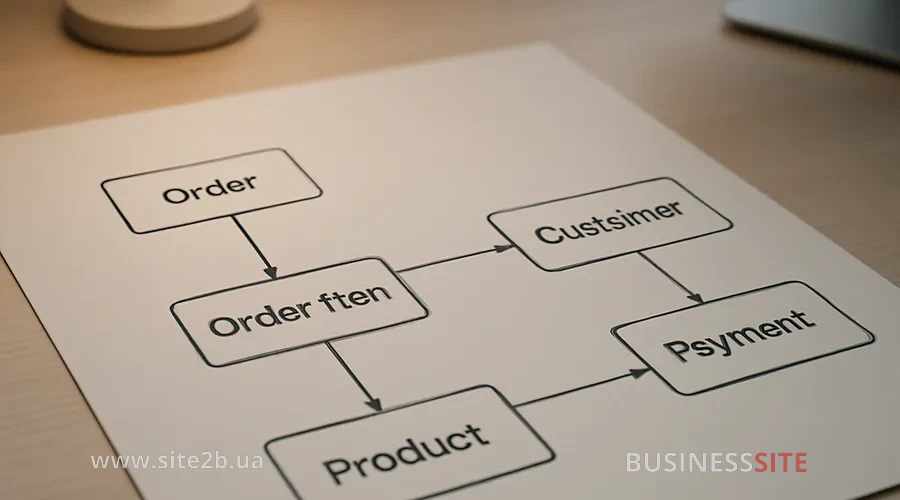
To summarize my experience:
- Start with the numbers
- analyze which 10–20% of pages generate 70–80% of revenue;
- check how many “junk” or weak URLs consume crawl budget and hinder indexing.
- Rebuild the semantic core and clusters
- focus on transactional and commercial queries;
- tie each cluster to a specific landing or solution: category, subcategory, landing page, filter.
- Design a hierarchy with 3 clicks to the target page
- simplify navigation;
- align URLs, meta tags, and H1–H3 with commercial intent.
- Set up internal linking and UX for conversion
- guide the user from entry to inquiry or payment in 2–4 steps;
- use CTAs, related blocks, and microdata.
- Carry out technical optimization and manage risks
- speed, mobile version, canonical URLs, indexing;
- redirect map and monitoring after changes.
BUSINESS SITE’s practice shows: when a business treats the SEO site structure for transactional queries without unnecessary pages as a strategic asset rather than as a “technical detail”, SEO begins to work as a sustainable sales channel with a clear ROI, not as a lottery. And the earlier you conduct an honest audit of the structure, the less money will be wasted on “unnecessary pages” and the sooner SEO will start delivering predictable results.
Rate the article: