
Imagine this: you have a website, but it gets lost in search results. Competitors outpace you in traffic and sales. You realize serious work on SEO and digital marketing is needed, but you face a choice that could cost you tens of thousands of hryvnias and months of time spent. Hire a freelancer? Build your own team? Entrust everything to an agency? Or try combining approaches?
Over fourteen years of working in web development and internet marketing, I’ve seen how this choice determines the fate of projects. Companies that came to BUSINESS SITE with the wrong site maintenance model often lost months to rework, overpaid for ineffective solutions or, conversely, skimped on quality and got results below expectations.
In this article I will share practical experience: how to choose the optimal site maintenance model for your business, what risks and advantages lurk behind each option, and why a hybrid approach often proves most effective. You’ll learn which metrics to track to understand whether your team is performing, and how to avoid the most common mistakes when working with contractors.
Goals of digital marketing for business: choosing a support model
Before choosing who will handle your website, you need to honestly answer the question: what do you want to achieve? Goals determine not only the strategy but also the requirements for the provider.
Increasing the brand’s online presence
If your main objective is for people to find you in search and know about you online, then we’re talking about search engine optimization, display/media campaigns and content marketing. This is long-term work that requires constant monitoring and adjustments. In our observations at BUSINESS SITE, such projects often require stable website support, either through an in-house team or through an agency with a long-term contract. Freelance can work here, but only for individual projects, for example for content writing or technical optimization.
Attracting the target audience and driving conversions
This requires more narrowly focused work: advertising campaigns, sales funnel optimization, testing landing pages. Specialists at BUSINESS SITE often recommend either an experienced freelancer with a portfolio or an agency that can offer a comprehensive approach. A one-person in-house team will be a bottleneck here.
Increasing sales and revenue
This is the most concrete goal, and it requires the most responsible approach. You need not just to attract traffic, but to turn it into money. The rule applies here: the higher the stakes, the higher the requirements for the provider. The BUSINESS SITE team in such cases often offers a hybrid model: an in-house specialist who understands the business, plus an agency for scaling and optimizing campaigns.
Customer engagement and loyalty
If you want not just to sell but to create a community around your brand, you need ongoing communication through content, social networks, email marketing. This requires a deep understanding of your business and audience. An in-house team has a clear advantage here, since it knows the nuances of your brand better and can react quickly to changes.
Data analytics and effectiveness
If you want to make decisions based on data rather than intuition, you need a results measurement system. This can be either an in-house analyst or an agency with its own tools and methodology. Freelancers are often ineffective here, as they require constant oversight and integration with other systems.
Website support models for businesses and their features

When I talk about website support models, I mean not just a payment method, but a whole system of organizing work that affects the quality, speed and predictability of results.
Freelance: pros, cons and risks
A freelancer is a specialist who works on your project under a contract, usually for a fixed price or an hourly rate. The advantages are obvious: you pay only for what you need, can quickly find a specialist with the required profile, and do not bear the costs of maintaining staff.
At the same time, BUSINESS SITE’s experience shows that freelance works well only for specific, time-limited tasks. For example, when you need to optimize the site structure, write content, or set up analytics. But if you need ongoing website support—position monitoring, competitor analysis, adaptation to changes in search engine algorithms—freelance becomes problematic.
Why? Because a freelancer works on several projects at once. Your project may be postponed if a more urgent or profitable order appears. In addition, if the freelancer suddenly stops responding or leaves the profession, you will be left without support at a critical moment.
In-house team: pros and cons
An in-house team is your own employees who work in the office or remotely but are fully focused on your business. It can be a single specialist or an entire department of several people.
The advantages here are obvious: full control over the process, deep understanding of your business, quick response to changes, and the ability to integrate marketing with other company departments. The in-house team becomes part of your organizational culture and can offer strategic ideas that go beyond routine execution.
But there are serious drawbacks. First, it’s expensive. The salary of a specialist in digital marketing in Ukraine is not only the base pay but also taxes, social contributions, training, and tools. Second, you depend on that person’s competence. If they don’t understand SEO or contextual advertising, you won’t get results. Third, there is a risk of losing a key specialist, and then the whole system will collapse.
In our experience at BUSINESS SITE, an in-house team works well for companies that already have a stable income and are ready to invest in long-term development. For startups or companies with a limited budget, this is often unjustified.
Agency: professionalism and control over scalability
An agency is a specialized company that provides services in digital marketing, SEO, contextual advertising and other areas. An agency has its own processes, tools, team of experts, and a portfolio of case studies.
The main advantage of an agency is professionalism and experience. An agency works with dozens or hundreds of clients, sees trends, and knows what works and what doesn’t. The BUSINESS SITE team, for example, has implemented projects for pharmaceutical companies, online stores, travel agencies and banks. Each project teaches us something new, and we apply that knowledge for all clients.
In addition, an agency can offer a comprehensive approach: not only SEO but also contextual advertising, SMM, content marketing, analytics. This allows you to create a unified brand communication concept and maximize results.
At the same time, there are drawbacks. First, the agency works with you as one of many clients. Your project may not be a priority if a larger order appears. Second, an agency is often more expensive than a freelancer or an in-house specialist. Third, you have less control over the process: you see the results but don’t always understand how they were achieved.
Hybrid model: three approaches in synergy
The hybrid model is a combination of two or three approaches. For example, an in-house specialist who is responsible for strategy and control, plus an agency that performs the main volume of work. Or an in-house team for content and SMM, plus a freelancer for technical optimization.
The hybrid model allows you to get the best of all worlds: control and understanding of the business from in-house, professionalism and scalability from the agency, flexibility and savings from freelance.
SWOT analysis of website support models — how to choose?
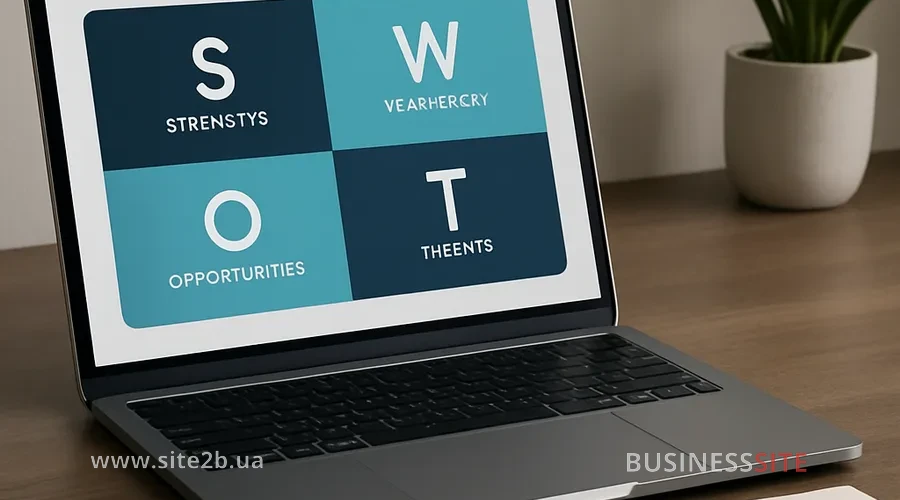
I often recommend that managers use SWOT analysis to choose a website support model. It helps to see the full picture and make an informed decision.
Strengths of the models
- Freelance: lower payroll costs, flexibility in selecting specialists, quick start, the ability to find a niche expert for a specific task.
- In-house: full control over the process, deep understanding of the business, quick response to changes, integration with other departments, the ability to influence corporate culture.
- Agency: professionalism and experience, a comprehensive approach, access to tools and methodologies, the ability to scale, stability and predictability.
Weaknesses of the models
- Freelance: instability, risk of losing the contractor, difficulty with long-term planning, need for constant supervision, limited resources and experience of a single person.
- In-house: high costs, dependence on the competence of one or several people, risk of losing a key specialist, difficulty scaling, need for continuous training and development.
- Agency: less control, may be more expensive, your project may not be a priority, difficulty integrating into your organization, risk of mismatched expectations.
Business opportunities and threats
Opportunities: each model provides access to new knowledge, tools, and approaches. Freelance lets you quickly scale the team, in-house allows you to deepen expertise, and an agency gives access to best practices.
Threats: dependence on external contractors, risk of losing key specialists, communication problems, data confidentiality issues, changes in the market that could make the chosen model ineffective.
Hybrid model of site support: in-house and agency together

In my experience, the most effective model is a hybrid approach where an in-house team works in tandem with an agency. Why does this work?
An in-house specialist (or a small team) is responsible for strategy, control, and integrating marketing with business processes. The agency performs the bulk of the work: SEO optimization, contextual advertising, content marketing, analytics.
This model allows you to get the best of both worlds: you retain control and business understanding while not overpaying to maintain a full in-house team. The agency can focus on what it does best, and the in-house specialist can focus on strategy and integration.
The practice of BUSINESS SITE shows that this model is especially effective for medium-sized companies that already have some experience in digital marketing and are ready to invest in long-term development.
Conditions for cooperation between an in-house team and an agency
Nevertheless, the hybrid model only works if several conditions are met.
- First, there must be a shared goal. The in-house team and the agency must understand where they are heading. It’s not just “increase traffic,” but specific numbers: “increase traffic by 50% in 6 months” or “bring 100 qualified leads per month.”
- Second, there must be a clear division of roles. Who is responsible for strategy? Who for execution? Who for quality control? Who for communication with other departments? If this is not defined, conflicts and duplicated work will begin.
- Third, expectations must be planned. Both parties must understand what can realistically be achieved within a given period. If the in-house specialist expects results in a month and the agency says it will take six months, that will create tension.
- Fourth, there must be a single point of contact. One person from the in-house side should be responsible for communication with the agency. This simplifies the process and avoids confusion.
- Fifth, there must be no internal competition. The in-house specialist should not feel that the agency is “taking their job.” On the contrary, they should see each other as partners who complement one another.
- Sixth, there must be mutual respect. The in-house specialist should respect the agency’s experience and professionalism. The agency should respect the in-house specialist’s knowledge of the business and its goals.
- Seventh, there should be knowledge sharing and joint brainstorming. The best ideas are born when people with different experience and perspectives on a problem work together. Regular meetings, discussion of results, error analysis – all of this helps improve outcomes.
How to measure the effectiveness of website support

Whatever option you choose, you need to understand whether it is working. For that you need metrics.
Which KPIs should be used to evaluate marketing?
- Search rankings. This is the main KPI for SEO. You should track the positions of your site for target queries. If rankings improve, then the work is going in the right direction.
- Traffic. How many people come to your site from search, social networks, advertising? Traffic should grow, and it should be quality traffic – people who are genuinely interested in your offer.
- Leads and conversions. This is the most important metric for a business. How many people completed the desired action: filled out a form, called, bought a product? If traffic increases but conversions fall, something is wrong.
- Pages per session. How many pages does a visitor view on average? If people arrive and leave immediately, the content does not interest them.
- ROI. How much money did you spend on marketing, and how much money did you earn? This is the most honest metric. If ROI is positive and growing, the chosen website support model is working.
How to increase digital marketing ROI by choosing the right provider
The choice of provider directly affects ROI. If you choose the wrong model, you may spend a lot of money and not get results.
For example, if you hire a freelancer who has no experience in your niche, the results will be worse than if you had chosen an agency that has already worked with similar companies.
Or if you hire an in-house specialist who has no experience in contextual advertising, you will not be able to scale campaigns and achieve maximum ROI.
Therefore, when choosing a provider you should consider not only the price, but also experience, portfolio, reviews, and work methodology. Investing in the right provider often pays off many times over.
How to choose a website support model

Now that you understand which models exist and how they work, here are some practical recommendations.
If you have a specific task for a certain period of time: for example, you need to optimize the site’s structure or write content, choose a freelancer. It will be cheaper and faster.
If you have a stable income and are ready to invest in long-term development – consider an in-house team. It will give you control and a deep understanding of the business.
If you need a comprehensive approach and want to get results quickly: choose an agency. It will be more expensive, but the results are often worth it.
If you want the best of all worlds, consider a hybrid model. An in-house specialist for strategy and control, an agency for execution.
When choosing, pay attention to the service provider’s experience in your niche, portfolio, reviews, working methodology, transparency of communication, and willingness to engage in long-term cooperation.
Conclusion: the choice that determines success
Choosing a website support model is not just an organizational matter. It’s a strategic decision that affects your business results, marketing expenses, and the speed of achieving your goals.
Freelancers work for specific tasks but are not suitable for long-term support. An in-house team provides control but requires greater investment. An agency offers professionalism and scalability, but you have less control.
The most effective model is a hybrid approach, where an in-house specialist works in tandem with an agency. This allows you to gain control, professionalism, and an optimal balance of costs and results.
Regardless of the chosen model, remember: success depends not only on the provider, but also on you. You should clearly define goals, regularly track metrics, be open to feedback, and be ready to adapt your strategy when necessary.
If you are ready to start working on website support and want to discuss which model will suit your business, I invite you to a consultation. The BUSINESS SITE team will help you understand the options and choose the optimal solution for your goals and budget.
Rate the article:





